Unit 6: Integration and
Accumulation of Change
单元 6:积分与
变化的累积
Connect differentiation and integration through the Fundamental Theorem of Calculus. Master Riemann sums, antiderivatives, and integration techniques.
通过微积分基本定理把微分与积分联系起来。掌握黎曼和、原函数与各种积分技巧。
Exploring Accumulations of Change
探索变化的累积
- Explain why the area between a rate graph and the $t$-axis gives the accumulated change.
- Calculate accumulated change from a rate graph using triangles, rectangles and trapezoids.
- State the units of an accumulation as (rate unit) $\times$ (input unit).
- Distinguish displacement (signed area) from total distance (area of $|v|$).
- Interpret the sign of an accumulation in context.
- 解释为什么变化率图像与 $t$ 轴之间的面积给出累积变化。
- 用三角形、矩形和梯形,从变化率图像计算累积变化。
- 说明累积量的单位是(变化率的单位)$\times$(自变量的单位)。
- 区分位移(有向面积)与总路程($|v|$ 下的面积)。
- 结合情境解释累积量的正负。
rate of change)函数的图像与 $x$ 轴之间的面积,代表变化的累积总量(total accumulation of change)。
Suppose $r(t)$ is a rate of change, for example gallons per minute flowing into a tank. Then the area under the curve $r(t)$ from $t = a$ to $t = b$ gives the total quantity that accumulated over that time interval. In some cases, you can compute this area using basic geometry (triangles, rectangles, trapezoids) before learning any formal integration techniques.
设 $r(t)$ 是一个变化率,比如流入水箱的加仑/分钟。那么曲线 $r(t)$ 从 $t = a$ 到 $t = b$ 之间的曲线下面积(area under curve),就给出在该时间区间内累积的总量。有时候,无需任何正式的积分技巧,仅用基本几何(三角形、矩形、梯形)就能算出这块面积。
gallons/min and time in min → area has units gallons/min × min = gallons.
Example: Rate in cars/hour and time in hours → area has units cars.
gallons/min,时间单位是 min → 面积的单位是 gallons/min × min = gallons。
例:变化率单位是 cars/hour,时间单位是 hours → 面积的单位是 cars。
Worked Example: Accumulation from a Rate Graph例题:由变化率图求累积
A tank fills at rate $r(t)$ gallons/hour. The graph of $r(t)$ forms a triangle with base 4 hours and height 6 gal/hr.
Total water added $=$ area under the rate curve:
$$\text{Area} = \tfrac{1}{2} \times 4 \times 6 = 12 \text{ gallons}$$水箱以变化率 $r(t)$ 加仑/小时进水。$r(t)$ 的图像是一个底为 4 小时、高为 6 加仑/小时的三角形。
累积的总水量 $=$ 变化率曲线下面积:
$$\text{Area} = \tfrac{1}{2} \times 4 \times 6 = 12 \text{ gallons}$$displacement)把它们带符号相加($5$ 米);总路程(total distance)把它们的大小相加($13$ 米)。Worked Example: Displacement and Distance from a Velocity Graph例题:由速度图求位移与路程
A particle moves along a line with velocity $v(t)=6-2t$ m/s for $0\le t\le 5$ (Figure 6.1). Its position at $t=0$ is $s(0)=2$ m. Find the displacement, the total distance travelled, and $s(5)$.
Step 1: Find where $v$ changes sign. $6-2t=0$ gives $t=3$; $v>0$ on $[0,3)$ and $v<0$ on $(3,5]$.
Step 2: Signed areas. On $[0,3]$ the triangle has base $3$ s and height $6$ m/s: $\tfrac12(3)(6)=9$ m. On $[3,5]$, $v(5)=-4$, so the triangle below the axis has area $\tfrac12(2)(4)=4$ m and counts as $-4$ m.
$$\text{displacement}=\int_0^5 v(t)\,dt=9+(-4)=5\text{ m},\qquad \text{distance}=\int_0^5 |v(t)|\,dt=9+4=13\text{ m}$$Step 3: Position. $s(5)=s(0)+\int_0^5 v(t)\,dt=2+5=7$ m. Check with an antiderivative: $\int_0^5(6-2t)\,dt=\bigl[6t-t^2\bigr]_0^5=30-25=5$.
Why this works: the integral of a rate adds area above the axis and subtracts area below it, so it measures net change; distance ignores direction, so every piece counts as positive.
一个质点沿直线运动,速度 $v(t)=6-2t$ 米/秒,$0\le t\le 5$(图 6.1)。$t=0$ 时位置 $s(0)=2$ 米。求位移、总路程和 $s(5)$。
第一步:找 $v$ 变号的位置。$6-2t=0$ 得 $t=3$;在 $[0,3)$ 上 $v>0$,在 $(3,5]$ 上 $v<0$。
第二步:有向面积。$[0,3]$ 上的三角形底为 $3$ 秒、高为 $6$ 米/秒:$\tfrac12(3)(6)=9$ 米。$[3,5]$ 上 $v(5)=-4$,横轴下方三角形的面积为 $\tfrac12(2)(4)=4$ 米,记作 $-4$ 米。
$$\text{displacement}=\int_0^5 v(t)\,dt=9+(-4)=5\text{ m},\qquad \text{distance}=\int_0^5 |v(t)|\,dt=9+4=13\text{ m}$$第三步:位置。$s(5)=s(0)+\int_0^5 v(t)\,dt=2+5=7$ 米。用原函数检验:$\int_0^5(6-2t)\,dt=\bigl[6t-t^2\bigr]_0^5=30-25=5$。
为什么成立:对变化率积分时,横轴上方的面积加上、下方的面积减去,所以它度量的是净变化(net change);路程不考虑方向,每一块都按正值计。
When a question asks for an amount from a rate, write the integral with its limits and $dt$, then give the value with units (rate unit $\times$ time unit). Read the wording: displacement or change in means the signed integral; total distance means $\int |v(t)|\,dt$, which needs the sign change located first.
题目要求由变化率求某个量时,写出带上下限和 $dt$ 的积分,再给出带单位的数值(变化率单位 $\times$ 时间单位)。注意措辞:位移或变化量(change in)指有向积分;总路程(total distance)指 $\int |v(t)|\,dt$,需要先找到变号点。
Water enters a tank at $r(t)$ liters per minute, with $t$ in minutes. What are the units and meaning of $\int_0^{10} r(t)\,dt$?水以 $r(t)$ 升/分钟流入水箱,$t$ 以分钟计。$\int_0^{10} r(t)\,dt$ 的单位和含义是什么?
Liters (liters per minute $\times$ minutes). It is the net amount of water that entered the tank during the first $10$ minutes.
单位是升(升/分钟 $\times$ 分钟)。它表示前 $10$ 分钟内流入水箱的净水量。
A rate $r(t)$ is negative on $[2,5]$. What happens to the quantity, and what is the sign of $\int_2^5 r(t)\,dt$?变化率 $r(t)$ 在 $[2,5]$ 上为负。该量如何变化?$\int_2^5 r(t)\,dt$ 的符号是什么?
The quantity decreases on $[2,5]$, and the integral is negative: it equals the (negative) net change over that interval.
该量在 $[2,5]$ 上减少,积分为负:它等于该区间上的(负的)净变化。
With $v(t)=6-2t$ m/s, find the displacement and the total distance on $[0,4]$.已知 $v(t)=6-2t$ 米/秒,求 $[0,4]$ 上的位移和总路程。
On $[0,3]$ the area is $9$ m. On $[3,4]$, $v(4)=-2$, so the triangle has area $\tfrac12(1)(2)=1$ m below the axis. Displacement $=9-1=8$ m (check: $\bigl[6t-t^2\bigr]_0^4=24-16=8$); distance $=9+1=10$ m.
$[0,3]$ 上面积为 $9$ 米。$[3,4]$ 上 $v(4)=-2$,横轴下方三角形面积为 $\tfrac12(1)(2)=1$ 米。位移 $=9-1=8$ 米(检验:$\bigl[6t-t^2\bigr]_0^4=24-16=8$);路程 $=9+1=10$ 米。
Approximating Areas with Riemann Sums
用黎曼和近似面积
- Calculate left, right and midpoint Riemann sums and the trapezoidal sum from a formula or a table.
- Calculate sums over subintervals of unequal width by using each subinterval's own $\Delta x$.
- Determine whether a left or right sum over- or underestimates when $f$ is increasing or decreasing.
- Determine whether a trapezoidal or midpoint sum over- or underestimates from the concavity of $f$.
- Explain why the sums approach the exact area as the number of subintervals grows.
- 由公式或表格计算左、右、中点黎曼和以及梯形和。
- 对不等宽子区间,用各自的 $\Delta x$ 计算和。
- 判断 $f$ 递增或递减时,左和或右和是高估还是低估。
- 根据 $f$ 的凹凸性判断梯形和或中点和是高估还是低估。
- 解释为什么子区间越多,和越接近精确面积。
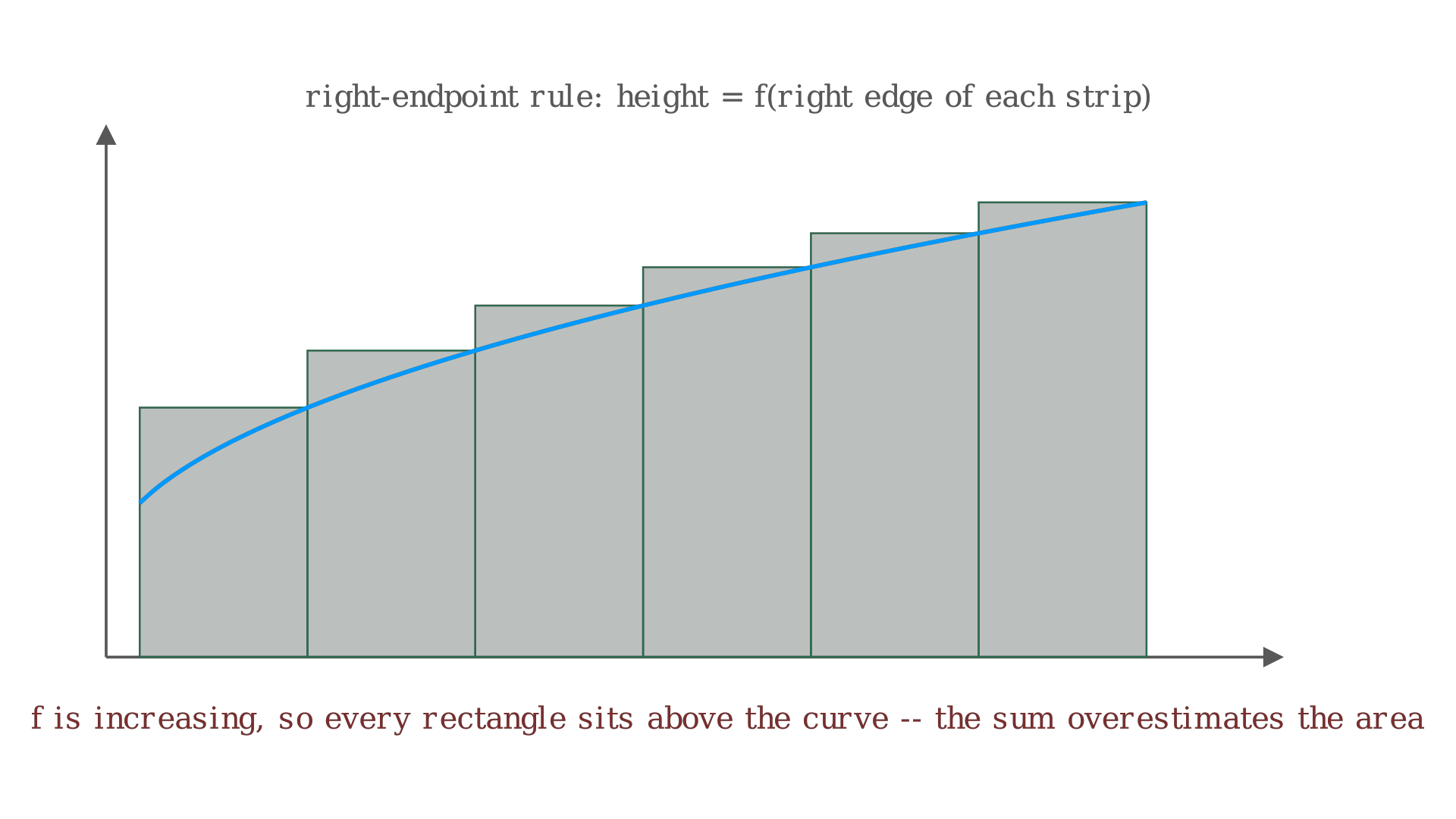
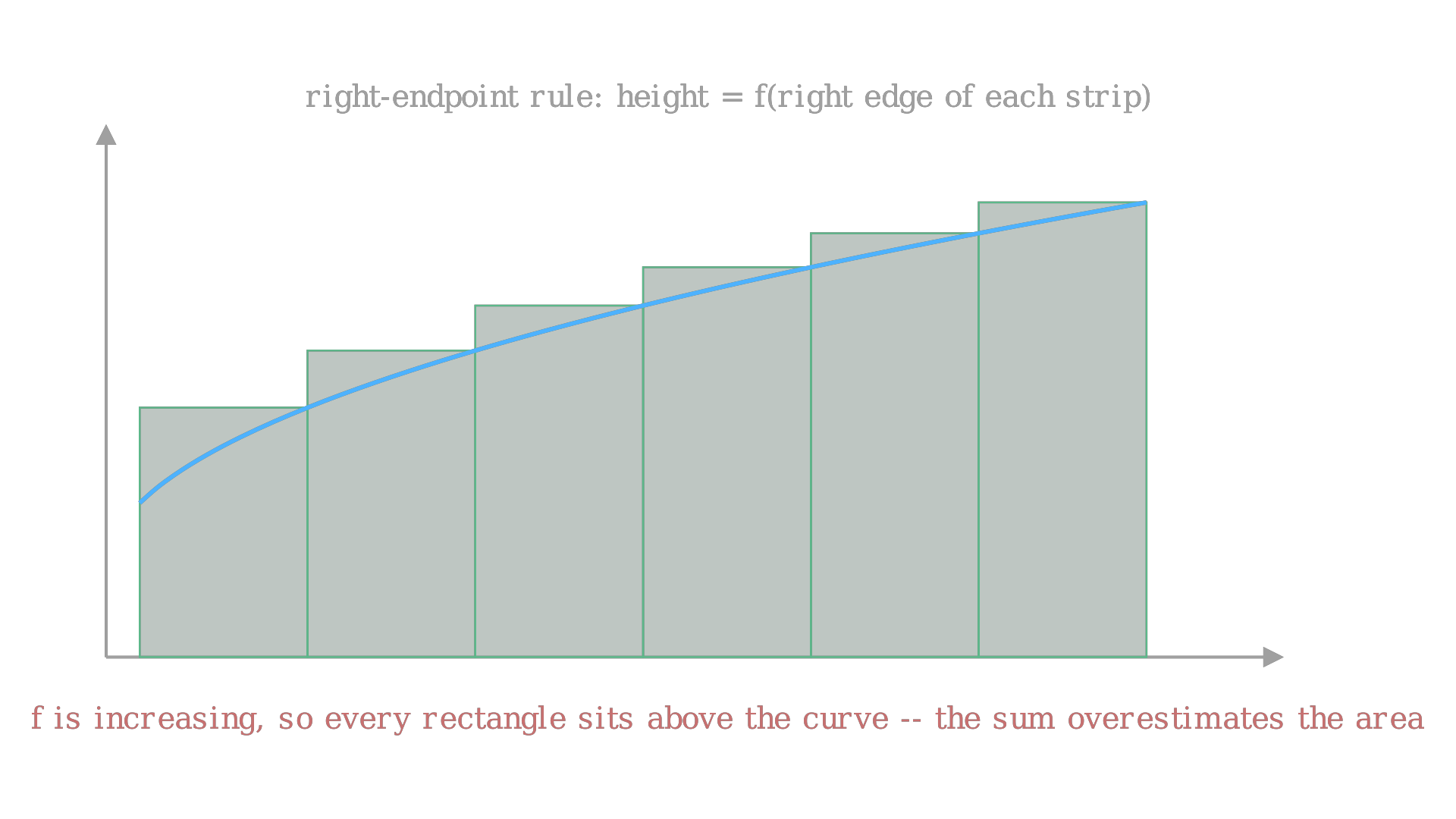
When the region under a curve isn't a simple geometric shape, we approximate the area by slicing it into thin rectangles. The total area of those rectangles, called a Riemann sum, estimates the true integral. The more rectangles we use, the better the estimate becomes.
当曲线下区域不是简单几何形状时,我们把它切成很多细长矩形来近似面积。这些矩形面积的总和,叫做黎曼和(Riemann sum),就是积分(integral)的估计值。矩形越多,估计越准。
As $n$ grows, the rectangles become narrower, and the gaps and overlaps between them and the curve shrink toward zero. That's the key geometric intuition: the Riemann sum converges to the exact area under the curve.
随着 $n$ 增大,矩形变得更窄,矩形与曲线之间的缝隙和重叠也逐步趋近于零。这就是核心的几何直觉:黎曼和收敛(convergence)到曲线下精确面积。
| Method | Height Chosen At | Over/Under? |
|---|---|---|
| Left Riemann Sum (LRS) | Left endpoint of each subinterval | Depends on increasing / decreasing |
| Right Riemann Sum (RRS) | Right endpoint of each subinterval | Depends on increasing / decreasing |
| Midpoint Riemann Sum (MRS) | Midpoint of each subinterval | Usually the most accurate of the three |
| Trapezoidal Sum | Average of left & right (trapezoid, not rectangle) | Depends on concavity |
| 方法 | 高度取在 | 高估/低估? |
|---|---|---|
左黎曼和(LRS) | 每个子区间的左端点 | 取决于递增/递减 |
右黎曼和(RRS) | 每个子区间的右端点 | 取决于递增/递减 |
中点黎曼和(MRS) | 每个子区间的中点 | 三者中通常最准 |
梯形和(trapezoidal sum) | 左右端点的平均(梯形而非矩形) | 取决于凹凸性 |
Worked Example: Left Riemann Sum from a Table例题:由表格求左黎曼和
Given table:
| $t$ | 0 | 1 | 3 | 6 |
| $f(t)$ | 2 | 5 | 4 | 7 |
Left Riemann Sum (3 nonuniform subintervals): $\Delta t_1 = 1,\; \Delta t_2 = 2,\; \Delta t_3 = 3$.
$$\begin{aligned} \text{LRS} &= f(0)\,\Delta t_1 + f(1)\,\Delta t_2 + f(3)\,\Delta t_3 \\[4pt] &= 2(1) + 5(2) + 4(3) \\[4pt] &= 2 + 10 + 12 = 24 \end{aligned}$$给定表格:
| $t$ | 0 | 1 | 3 | 6 |
| $f(t)$ | 2 | 5 | 4 | 7 |
左黎曼和(3 个非等距子区间):$\Delta t_1 = 1,\; \Delta t_2 = 2,\; \Delta t_3 = 3$。
$$\begin{aligned} \text{LRS} &= f(0)\,\Delta t_1 + f(1)\,\Delta t_2 + f(3)\,\Delta t_3 \\[4pt] &= 2(1) + 5(2) + 4(3) \\[4pt] &= 2 + 10 + 12 = 24 \end{aligned}$$Worked Example: Left, Right and Midpoint Sums for $x^2$例题:求 $x^2$ 的左、右、中点和
Approximate $\int_0^2 x^2\,dx$ with $n=4$ equal subintervals using left, right and midpoint sums and the trapezoidal sum (Figure 6.2), and compare with the exact value.
Step 1: Width and sample points. $\Delta x=\frac{2-0}{4}=0.5$. Left endpoints $0,\,0.5,\,1,\,1.5$; right endpoints $0.5,\,1,\,1.5,\,2$; midpoints $0.25,\,0.75,\,1.25,\,1.75$.
$$\begin{aligned} L_4&=0.5\,(0+0.25+1+2.25)=0.5(3.5)=1.75\\[4pt] R_4&=0.5\,(0.25+1+2.25+4)=0.5(7.5)=3.75\\[4pt] M_4&=0.5\,(0.0625+0.5625+1.5625+3.0625)=0.5(5.25)=2.625\\[4pt] T_4&=\tfrac12(L_4+R_4)=\tfrac12(1.75+3.75)=2.75 \end{aligned}$$Step 2: Compare. Exactly, $\int_0^2 x^2\,dx=\tfrac{8}{3}\approx 2.667$. Since $x^2$ is increasing on $[0,2]$, $L_4<\tfrac83<R_4$; since it is concave up, $M_4<\tfrac83<T_4$.
Why this works: the rule for over or under comes from where each rectangle's height is sampled relative to the curve, so the computed numbers must land on the side the rule predicts.
用 $n=4$ 个等宽子区间,以左、右、中点和以及梯形和近似 $\int_0^2 x^2\,dx$(图 6.2),并与精确值比较。
第一步:宽度与取样点。$\Delta x=\frac{2-0}{4}=0.5$。左端点 $0,\,0.5,\,1,\,1.5$;右端点 $0.5,\,1,\,1.5,\,2$;中点 $0.25,\,0.75,\,1.25,\,1.75$。
$$\begin{aligned} L_4&=0.5\,(0+0.25+1+2.25)=0.5(3.5)=1.75\\[4pt] R_4&=0.5\,(0.25+1+2.25+4)=0.5(7.5)=3.75\\[4pt] M_4&=0.5\,(0.0625+0.5625+1.5625+3.0625)=0.5(5.25)=2.625\\[4pt] T_4&=\tfrac12(L_4+R_4)=\tfrac12(1.75+3.75)=2.75 \end{aligned}$$第二步:比较。精确值 $\int_0^2 x^2\,dx=\tfrac{8}{3}\approx 2.667$。因为 $x^2$ 在 $[0,2]$ 上递增,$L_4<\tfrac83<R_4$;因为它上凹,$M_4<\tfrac83<T_4$。
为什么成立:高估或低估取决于每个矩形的高在曲线上的取样位置,所以算出的数值必然落在规则预言的一侧。
With a table of unequal widths, multiply each height by its own $\Delta x$; do not use $\frac{b-a}{n}$. When you claim an over- or underestimate, state the reason ("$f$ is increasing, so the left sum is an underestimate"). A table alone does not tell you $f$ is monotonic or concave, so make the claim only when the problem gives that property.
表格中子区间宽度不等时,每个高要乘以各自的 $\Delta x$,不要用 $\frac{b-a}{n}$。判断高估或低估时要写出理由(“$f$ 递增,所以左和低估”)。仅凭表格无法知道 $f$ 单调或凹凸,只有题目给出该性质时才能下结论。
Using the table above ($t=0,1,3,6$; $f(t)=2,5,4,7$), compute the right Riemann sum.用上面的表格($t=0,1,3,6$;$f(t)=2,5,4,7$)计算右黎曼和。
$R=f(1)(1)+f(3)(2)+f(6)(3)=5+8+21=34$.
$R=f(1)(1)+f(3)(2)+f(6)(3)=5+8+21=34$。
Using the same table, compute the trapezoidal sum.用同一表格计算梯形和。
$T=\tfrac12\bigl[(2+5)(1)+(5+4)(2)+(4+7)(3)\bigr]=\tfrac12(7+18+33)=29$. Check: $\tfrac12(L+R)=\tfrac12(24+34)=29$.
$T=\tfrac12\bigl[(2+5)(1)+(5+4)(2)+(4+7)(3)\bigr]=\tfrac12(7+18+33)=29$。检验:$\tfrac12(L+R)=\tfrac12(24+34)=29$。
$f$ is decreasing and concave down on $[a,b]$. Order $L$, $R$, $T$ and $\int_a^b f(x)\,dx$ from smallest to largest.$f$ 在 $[a,b]$ 上递减且下凹。把 $L$、$R$、$T$ 和 $\int_a^b f(x)\,dx$ 从小到大排序。
Decreasing: $L$ overestimates and $R$ underestimates. Concave down: $T$ underestimates. Since $T=\tfrac12(L+R)$ lies between $R$ and $L$: $R<T<\int_a^b f(x)\,dx<L$.
递减:$L$ 高估,$R$ 低估。下凹:$T$ 低估。又 $T=\tfrac12(L+R)$ 介于 $R$ 与 $L$ 之间,所以 $R<T<\int_a^b f(x)\,dx<L$。
Riemann Sums, Summation Notation & Definite Integral Notation
黎曼和、求和记号与定积分记号
- State the definition of the definite integral as a limit of Riemann sums.
- Identify $\Delta x$, $a$, $b$ and $f$ in a limit of a Riemann sum.
- Express a limit of a Riemann sum as a definite integral.
- Write a definite integral as a limit of right-endpoint Riemann sums.
- Explain each part of the notation $\int_a^b f(x)\,dx$.
- 陈述定积分作为黎曼和极限的定义。
- 在黎曼和的极限中识别 $\Delta x$、$a$、$b$ 和 $f$。
- 把黎曼和的极限写成定积分。
- 把定积分写成右端点黎曼和的极限。
- 解释记号 $\int_a^b f(x)\,dx$ 的每个部分。
The interactive visualizer above showed you the key idea geometrically. Now we formalize it: the definite integral is defined as the limit of Riemann sums as the number of rectangles approaches infinity and their widths approach zero.
上方的交互可视化已从几何上展示了关键思路。现在把它正式化:定积分(definite integral)被定义为黎曼和的极限:当矩形数趋于无穷、宽度趋于零时的极限值。
This is the foundational definition. The integral symbol $\int$ is an elongated "S" for Sum. The $dx$ is the infinitesimal remnant of $\Delta x$. Every time you write $\int_a^b f(x)\,dx$, you are writing a limit of a sum of products: infinitely many, infinitely thin rectangles whose total area equals the exact area under the curve.
这是最根本的定义。积分号 $\int$ 是拉长了的字母 “S”,表示 Sum(求和)。$dx$ 是 $\Delta x$ 在取极限后留下的“无穷小”痕迹。每写一个 $\int_a^b f(x)\,dx$,你就是在写一个乘积之和的极限:无穷多个、无穷薄的矩形,其总面积等于曲线下精确面积。
limit)给出精确值。这个极限就是定积分。这与导数(derivative)被定义为差商的极限是类比的:积分被定义为求和的极限。
For equal subintervals of width $\Delta x = \frac{b-a}{n}$, the definition simplifies:
当子区间为等宽 $\Delta x = \frac{b-a}{n}$ 时,定义可简化为:
integrand),即我们要算其面积的函数
$dx$:微分,标明积分变量,并提醒这是无穷小宽度 $\Delta x$
合起来,$f(x)\,dx$ 表示每个无穷小矩形的“高 × 宽”。
Worked Example: Converting Sum to Integral例题:把求和改写为积分
Express as a definite integral:
$$\lim_{n \to \infty} \sum_{i=1}^{n} \left(3 + \frac{5i}{n}\right)^{\!2} \cdot \frac{5}{n}$$Identify the pieces: $\Delta x = \frac{5}{n}$, so $b - a = 5$. The starting value is $a = 3$, giving $b = 8$, and $f(x) = x^2$.
$$= \int_3^8 x^2\,dx$$把下式表示为定积分:
$$\lim_{n \to \infty} \sum_{i=1}^{n} \left(3 + \frac{5i}{n}\right)^{\!2} \cdot \frac{5}{n}$$识别各部分:$\Delta x = \frac{5}{n}$,所以 $b - a = 5$。起点 $a = 3$,故 $b = 8$,且 $f(x) = x^2$。
$$= \int_3^8 x^2\,dx$$Worked Example: Writing an Integral as a Limit of Sums例题:把积分写成求和的极限
Write $\displaystyle\int_2^5 (x^2+1)\,dx$ as a limit of right-endpoint Riemann sums.
Step 1: Width. $\Delta x=\frac{5-2}{n}=\frac{3}{n}$.
Step 2: Right endpoints. $x_i=a+i\,\Delta x=2+\frac{3i}{n}$ for $i=1,\dots,n$.
$$\int_2^5 (x^2+1)\,dx=\lim_{n\to\infty}\sum_{i=1}^{n}\left[\left(2+\frac{3i}{n}\right)^{\!2}+1\right]\frac{3}{n}$$Step 3: Check by reading it back. $\frac{3}{n}$ gives $b-a=3$; at $i=n$ the sample point is $2+3=5=b$; the bracket is $f(x)=x^2+1$. (Value: $\bigl[\tfrac{x^3}{3}+x\bigr]_2^5=\tfrac{140}{3}-\tfrac{14}{3}=42$.)
Why this works: the right-endpoint formula is the definition with $x_i^*=x_i$ and equal widths, so every piece of the integral appears once in the sum.
把 $\displaystyle\int_2^5 (x^2+1)\,dx$ 写成右端点黎曼和的极限。
第一步:宽度。$\Delta x=\frac{5-2}{n}=\frac{3}{n}$。
第二步:右端点。$x_i=a+i\,\Delta x=2+\frac{3i}{n}$,$i=1,\dots,n$。
$$\int_2^5 (x^2+1)\,dx=\lim_{n\to\infty}\sum_{i=1}^{n}\left[\left(2+\frac{3i}{n}\right)^{\!2}+1\right]\frac{3}{n}$$第三步:反向读回检验。由 $\frac{3}{n}$ 得 $b-a=3$;$i=n$ 时取样点为 $2+3=5=b$;方括号内是 $f(x)=x^2+1$。(数值:$\bigl[\tfrac{x^3}{3}+x\bigr]_2^5=\tfrac{140}{3}-\tfrac{14}{3}=42$。)
为什么成立:右端点公式就是取 $x_i^*=x_i$、等宽子区间时的定义,积分的每个部分在和式中各出现一次。
One limit can match several integrals: $\lim_{n\to\infty}\sum_{i=1}^{n}\left(3+\frac{5i}{n}\right)^{2}\frac{5}{n}$ equals $\int_3^8 x^2\,dx$ and also $\int_0^5 (3+x)^2\,dx$. When matching an answer choice, confirm $\Delta x$, the first sample point and the integrand together rather than matching the look of one piece.
同一个极限可以对应多个积分:$\lim_{n\to\infty}\sum_{i=1}^{n}\left(3+\frac{5i}{n}\right)^{2}\frac{5}{n}$ 既等于 $\int_3^8 x^2\,dx$,也等于 $\int_0^5 (3+x)^2\,dx$。核对选项时要同时确认 $\Delta x$、首个取样点和被积函数,不要只看某一部分像不像。
Write $\lim_{n\to\infty}\sum_{i=1}^{n}\left(1+\frac{2i}{n}\right)^{3}\frac{2}{n}$ as a definite integral and evaluate it.把 $\lim_{n\to\infty}\sum_{i=1}^{n}\left(1+\frac{2i}{n}\right)^{3}\frac{2}{n}$ 写成定积分并求值。
$\Delta x=\frac{2}{n}$, $a=1$, $b=3$, $f(x)=x^3$: $\int_1^3 x^3\,dx=\frac{81-1}{4}=20$.
$\Delta x=\frac{2}{n}$,$a=1$,$b=3$,$f(x)=x^3$:$\int_1^3 x^3\,dx=\frac{81-1}{4}=20$。
Which integral is $\lim_{n\to\infty}\sum_{i=1}^{n}\sqrt{\frac{4i}{n}}\cdot\frac{4}{n}$? Evaluate it.$\lim_{n\to\infty}\sum_{i=1}^{n}\sqrt{\frac{4i}{n}}\cdot\frac{4}{n}$ 是哪个积分?求其值。
$\int_0^4 \sqrt{x}\,dx=\bigl[\tfrac23 x^{3/2}\bigr]_0^4=\tfrac23(8)=\tfrac{16}{3}$.
$\int_0^4 \sqrt{x}\,dx=\bigl[\tfrac23 x^{3/2}\bigr]_0^4=\tfrac23(8)=\tfrac{16}{3}$。
For $\int_2^7 f(x)\,dx$ with $n$ equal subintervals, state $\Delta x$ and the right endpoint $x_i$.对 $\int_2^7 f(x)\,dx$ 取 $n$ 个等宽子区间,写出 $\Delta x$ 和右端点 $x_i$。
$\Delta x=\frac{7-2}{n}=\frac{5}{n}$ and $x_i=2+\frac{5i}{n}$, so $x_n=7$.
$\Delta x=\frac{7-2}{n}=\frac{5}{n}$,$x_i=2+\frac{5i}{n}$,所以 $x_n=7$。
The Fundamental Theorem of Calculus & Accumulation Functions
微积分基本定理与累积函数
- State the Fundamental Theorem of Calculus Part 1 and its continuity condition.
- Calculate $\frac{d}{dx}\int_a^{g(x)} f(t)\,dt$ using the chain rule.
- Calculate the derivative when the variable appears in the lower limit.
- Calculate the derivative when both limits depend on $x$.
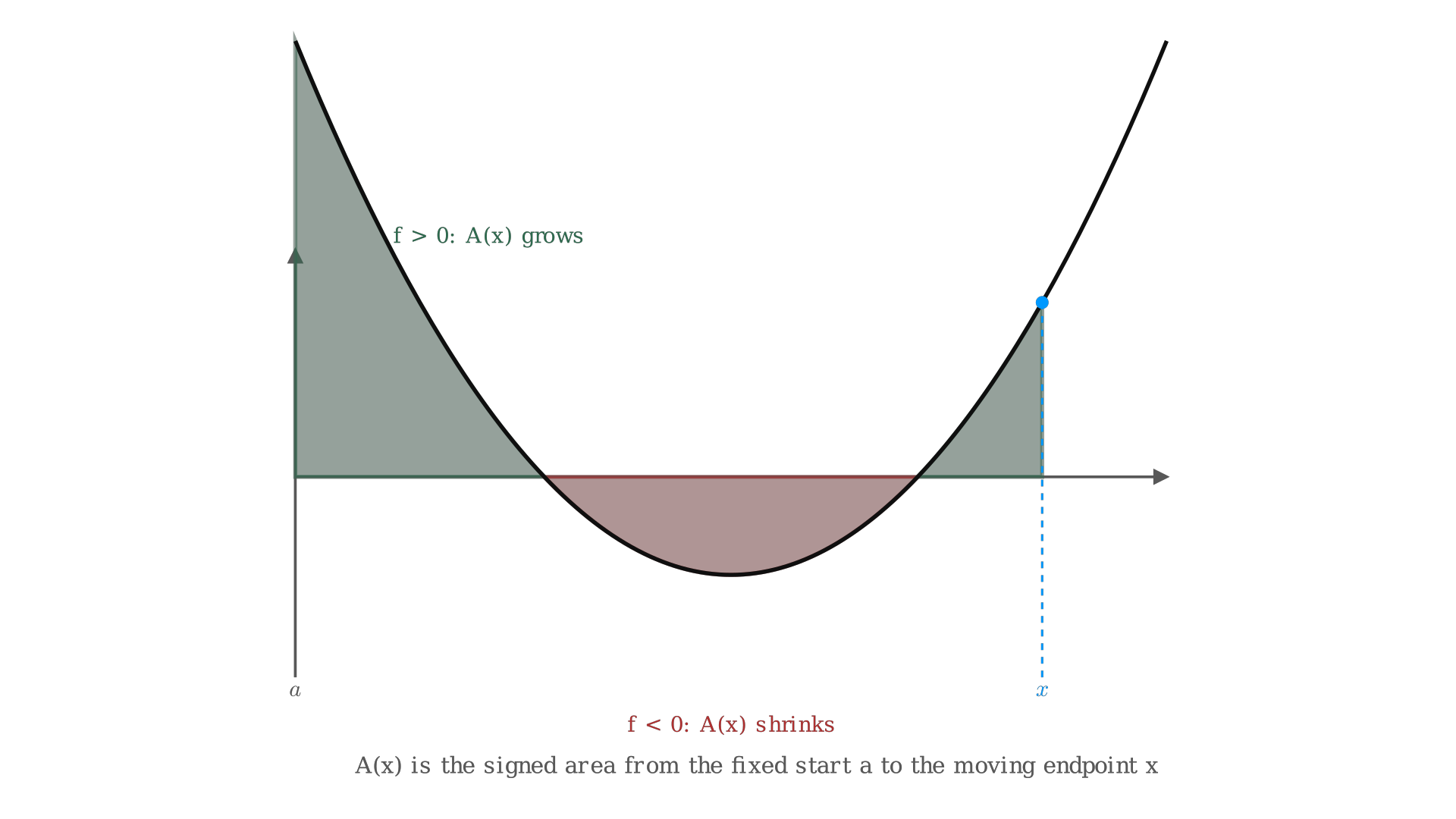
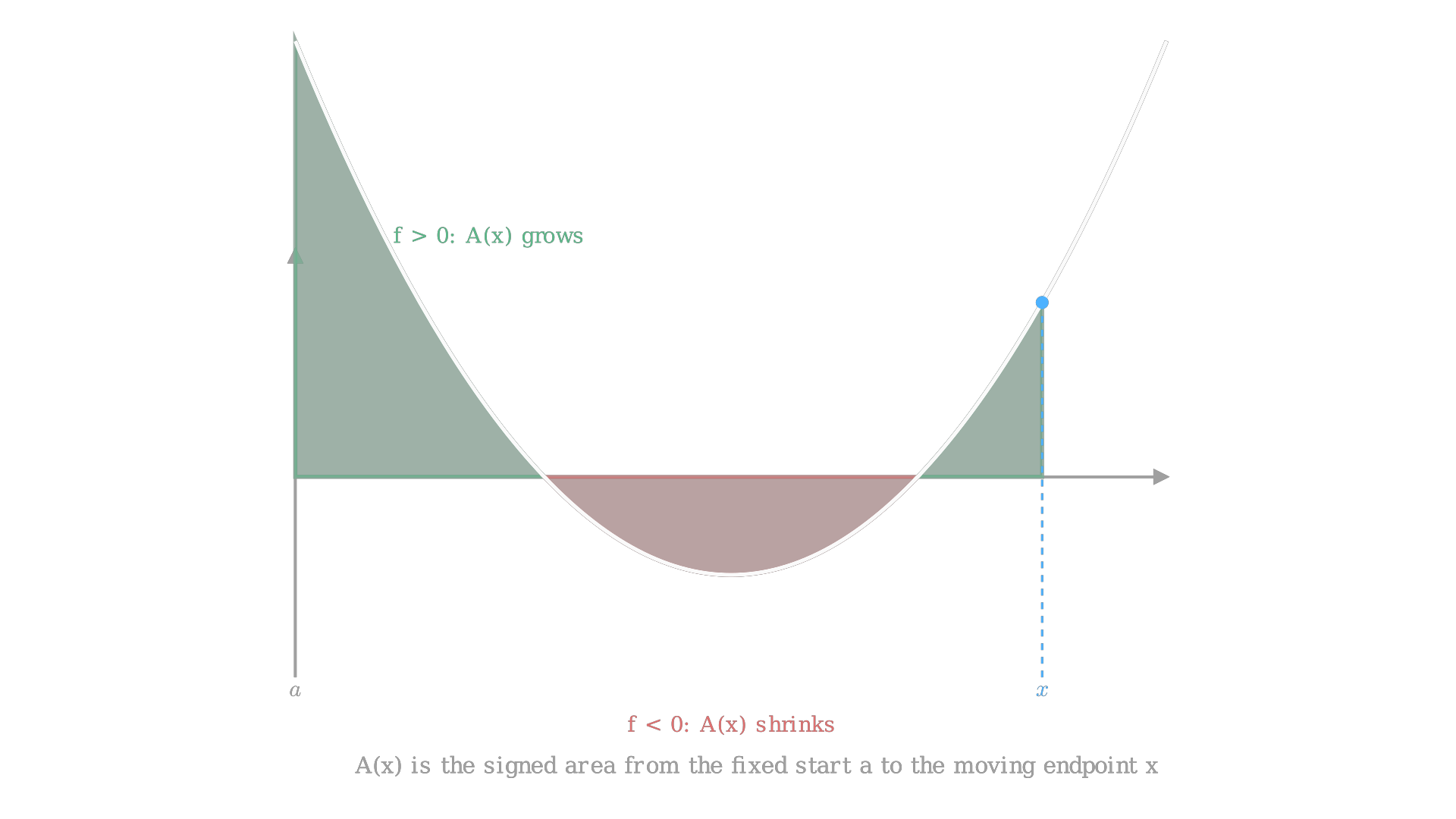
- Explain $F(x)=\int_a^x f(t)\,dt$ as an accumulated signed area.
- 陈述微积分基本定理第一部分及其连续性条件。
- 用链式法则计算 $\frac{d}{dx}\int_a^{g(x)} f(t)\,dt$。
- 计算变量出现在下限时的导数。
- 计算上下限都依赖 $x$ 时的导数。
- 把 $F(x)=\int_a^x f(t)\,dt$ 解释为累积的有向面积。
Fundamental Theorem of Calculus, FTC)是本单元最重要的结论:微分和积分是互为逆运算的过程。
where $f$ is continuous on an interval containing $a$
其中 $f$ 在包含 $a$ 的区间上连续
This tells us: if you accumulate a continuous function from a fixed starting point $a$ up to a variable endpoint $x$, then the rate at which that accumulation changes is just the original function evaluated at $x$.
这告诉我们:把一个连续函数从固定起点 $a$ 累积到一个可变的端点 $x$,那么这个累积量变化的速率恰好就是原函数在 $x$ 处的值。
Worked Example: FTC Part 1 with Chain Rule例题:FTC 第一部分配合链式法则
Find $F'(x)$ if $\displaystyle F(x) = \int_1^{x^2} \cos(t^3)\,dt$.
Upper limit $g(x) = x^2 \;\Longrightarrow\; g'(x) = 2x$. Integrand: $f(t) = \cos(t^3)$.
$$\begin{aligned} F'(x) &= f\bigl(g(x)\bigr)\cdot g'(x) \\[4pt] &= \cos\bigl((x^2)^3\bigr)\cdot 2x \\[4pt] &= 2x\cos(x^6) \end{aligned}$$若 $\displaystyle F(x) = \int_1^{x^2} \cos(t^3)\,dt$,求 $F'(x)$。
上限 $g(x) = x^2 \;\Longrightarrow\; g'(x) = 2x$。被积函数:$f(t) = \cos(t^3)$。
$$\begin{aligned} F'(x) &= f\bigl(g(x)\bigr)\cdot g'(x) \\[4pt] &= \cos\bigl((x^2)^3\bigr)\cdot 2x \\[4pt] &= 2x\cos(x^6) \end{aligned}$$If $g(x)=\int_{x}^{x^2}\cos t\,dt$, apply the chain rule to each limit separately: $g'(x)=\cos(x^2)\cdot 2x-\cos(x)\cdot 1$. Writing only $\cos(x^2)\cdot2x$ loses the lower-limit term. Check: $g(x)=\sin(x^2)-\sin x$, and differentiating gives the same answer.
若 $g(x)=\int_{x}^{x^2}\cos t\,dt$,要对每个上下限分别用链式法则:$g'(x)=\cos(x^2)\cdot 2x-\cos(x)\cdot 1$。只写 $\cos(x^2)\cdot2x$ 会漏掉下限项。检验:$g(x)=\sin(x^2)-\sin x$,求导得到相同结果。
Worked Example: FTC Part 1 with Chain Rule on the Lower Limit例题:FTC 第一部分作用在下限的链式法则
Find $H'(x)$ if $\displaystyle H(x) = \int_{x^2}^{3} \cos t\,dt$.
Step 1: Reverse the bounds. Use the property $\int_a^b = -\int_b^a$ so the variable bound is on top:
$$ H(x) \;=\; -\int_{3}^{x^2} \cos t\,dt $$Step 2: Apply FTC Part 1 with chain rule on the upper limit. Now $g(x)=x^2$, $g'(x)=2x$, integrand $f(t)=\cos t$:
$$\begin{aligned} H'(x) &= -\,f\!\bigl(g(x)\bigr)\cdot g'(x) \\[4pt] &= -\cos(x^2)\cdot 2x \\[4pt] &= -\,2x\cos(x^2) \end{aligned}$$Sanity check. The minus sign comes from reversing the bounds, not from anything in the integrand. If you skip Step 1 and apply the chain-rule formula directly to a lower-limit integral, you will get the wrong sign.
若 $\displaystyle H(x) = \int_{x^2}^{3} \cos t\,dt$,求 $H'(x)$。
第一步:交换上下限。用性质 $\int_a^b = -\int_b^a$,把变量限放到上方:
$$ H(x) \;=\; -\int_{3}^{x^2} \cos t\,dt $$第二步:对上限用 FTC 第一部分 + 链式法则。此时 $g(x)=x^2$,$g'(x)=2x$,被积函数 $f(t)=\cos t$:
$$\begin{aligned} H'(x) &= -\,f\!\bigl(g(x)\bigr)\cdot g'(x) \\[4pt] &= -\cos(x^2)\cdot 2x \\[4pt] &= -\,2x\cos(x^2) \end{aligned}$$核对一下。负号是因为交换上下限而出现的,不是被积函数带来的。如果跳过第一步,直接把链式公式套到下限变量的积分上,符号一定会算错。
Substitute the limit into the integrand, then multiply by the derivative of that limit; for a variable lower limit, reverse the bounds first. Do not try to antidifferentiate first: an integrand like $\cos(t^3)$ has no elementary antiderivative, and FTC Part 1 does not need one.
把上下限代入被积函数,再乘以该限的导数;变量在下限时先交换上下限。不要先求原函数:像 $\cos(t^3)$ 这样的被积函数没有初等原函数,而 FTC 第一部分根本不需要它。
Find $\frac{d}{dx}\int_0^x e^{-t^2}\,dt$.求 $\frac{d}{dx}\int_0^x e^{-t^2}\,dt$。
$e^{-x^2}$, directly from FTC Part 1 (the upper limit is $x$, so the chain-rule factor is $1$).
$e^{-x^2}$,直接由 FTC 第一部分得到(上限是 $x$,链式因子为 $1$)。
For $x>0$, find $\frac{d}{dx}\int_{2x}^{x^2}\ln t\,dt$.当 $x>0$ 时,求 $\frac{d}{dx}\int_{2x}^{x^2}\ln t\,dt$。
Upper term minus lower term: $\ln(x^2)\cdot 2x-\ln(2x)\cdot 2=4x\ln x-2\ln(2x)$.
上限项减下限项:$\ln(x^2)\cdot 2x-\ln(2x)\cdot 2=4x\ln x-2\ln(2x)$。
Let $F(x)=\int_1^x (t^2-4)\,dt$. Find $F(1)$, $F'(3)$, and where $F$ has a horizontal tangent for $x>0$.设 $F(x)=\int_1^x (t^2-4)\,dt$。求 $F(1)$、$F'(3)$,以及 $x>0$ 时 $F$ 在何处有水平切线。
$F(1)=\int_1^1(\dots)\,dt=0$. $F'(x)=x^2-4$, so $F'(3)=5$. $F'(x)=0$ at $x=2$.
$F(1)=\int_1^1(\dots)\,dt=0$。$F'(x)=x^2-4$,所以 $F'(3)=5$。$F'(x)=0$ 在 $x=2$ 处。
Interpreting the Behavior of Accumulation Functions
解读累积函数的行为
- Explain why $g'(x)=f(x)$ when $g(x)=\int_a^x f(t)\,dt$.
- Determine where $g$ increases or decreases from the sign of $f$.
- Locate relative and absolute extrema of $g$ and justify them with $f$.
- Locate inflection points of $g$ where $f$ changes from increasing to decreasing or vice versa.
- Calculate values of $g$ from signed geometric areas under the graph of $f$.
- 解释为什么当 $g(x)=\int_a^x f(t)\,dt$ 时 $g'(x)=f(x)$。
- 由 $f$ 的符号判断 $g$ 的增减区间。
- 找出 $g$ 的相对极值与绝对极值,并用 $f$ 加以论证。
- 在 $f$ 由增变减(或由减变增)处找出 $g$ 的拐点。
- 用 $f$ 图像下的有向几何面积计算 $g$ 的值。
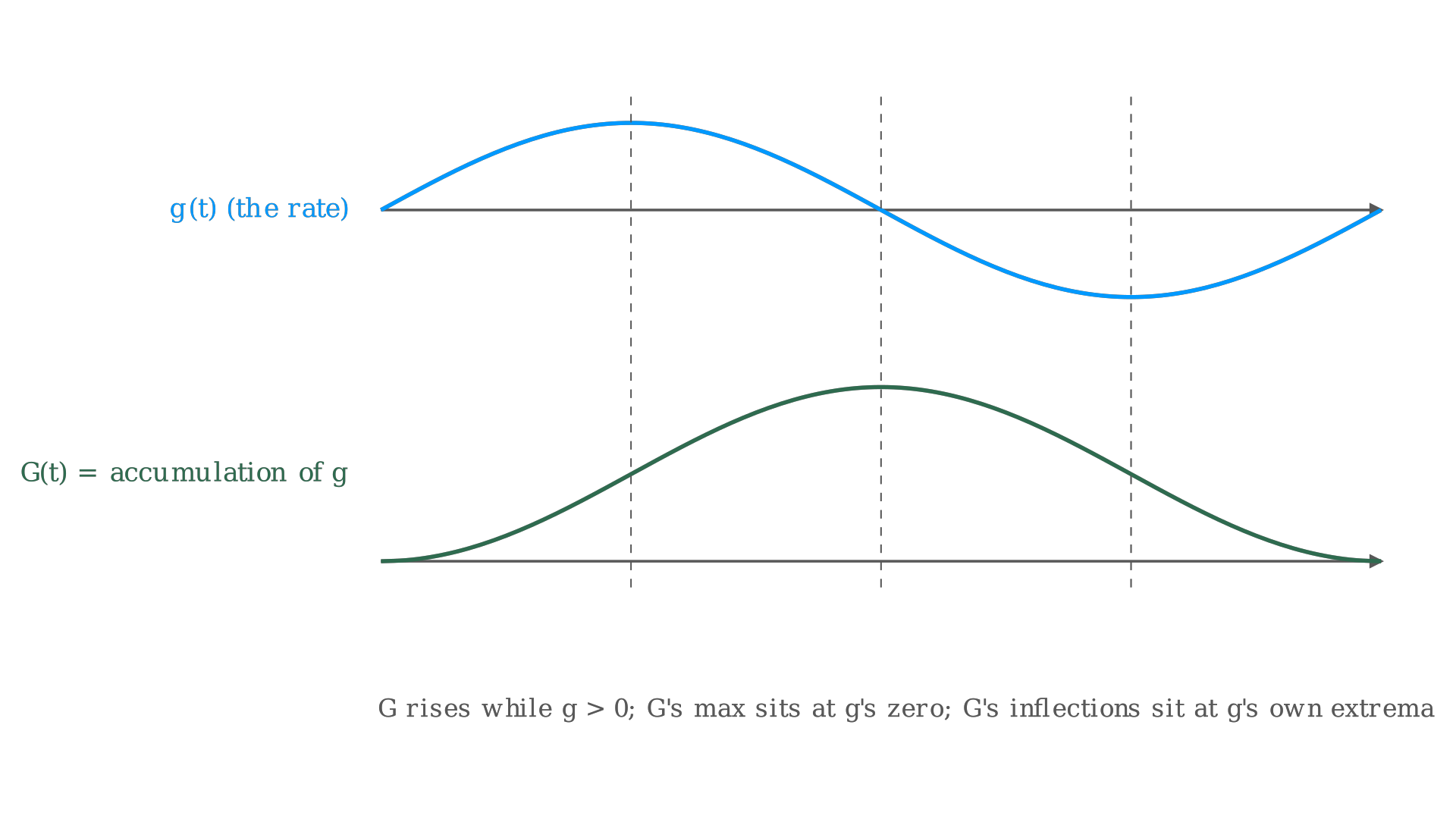
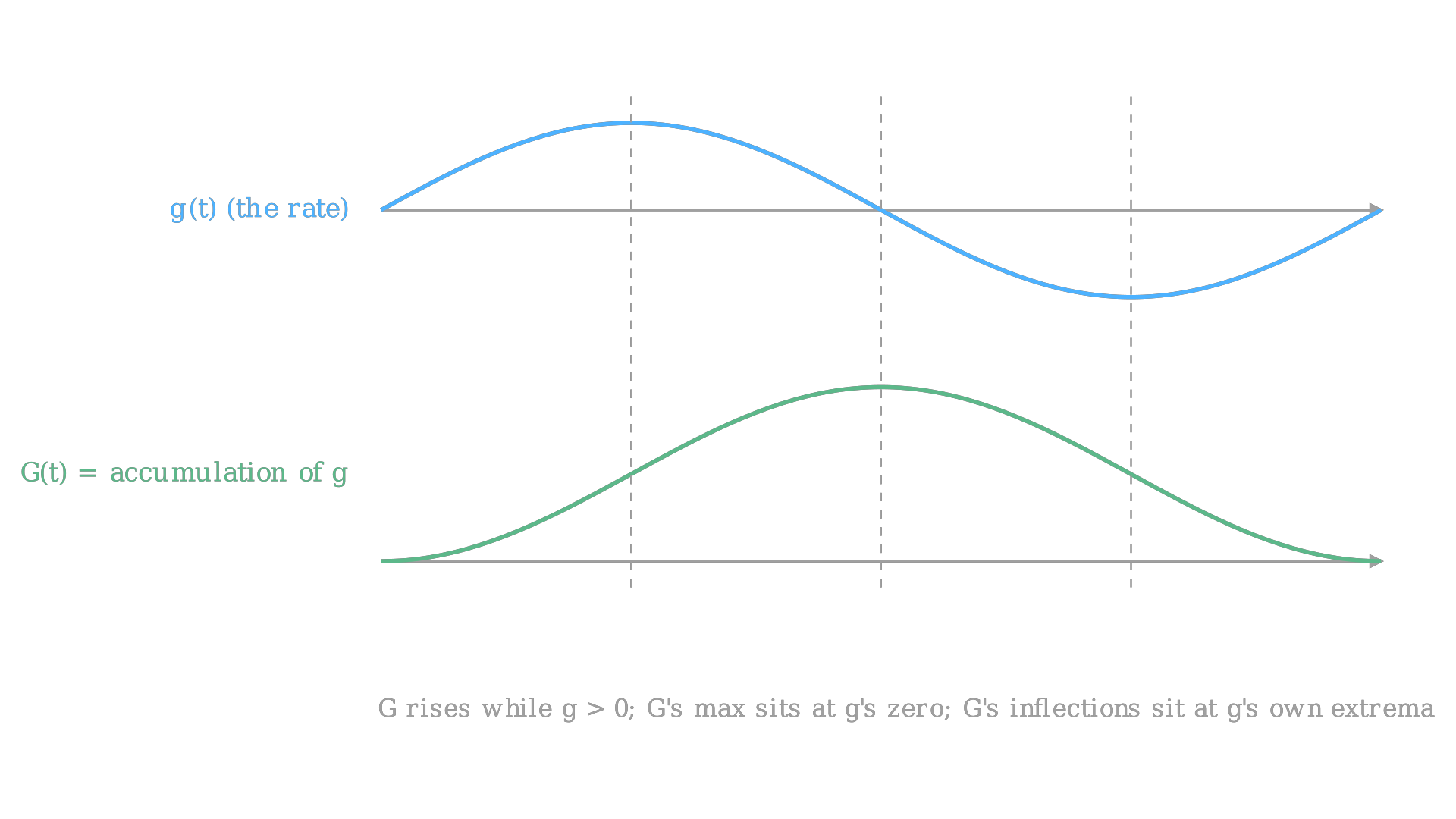
If $g(x) = \int_a^x f(t)\,dt$, then the graph of $f$ tells you everything about the behavior of $g$. Since $g'(x) = f(x)$ by FTC Part 1, the graph of $f$ is literally the derivative graph of $g$, so all the analysis techniques from Unit 5 apply directly.
若 $g(x) = \int_a^x f(t)\,dt$,则 $f$ 的图像就能告诉你 $g$ 的全部行为。因为由 FTC 第一部分 $g'(x) = f(x)$,$f$ 的图像其实就是 $g$ 的导数图,所以单元 5 的所有分析技巧都可以直接套用。
| If $f(t)$ is… | Then $g(x)$ is… | Because… |
|---|---|---|
| Positive | Increasing | $g' = f > 0$ → accumulation is growing |
| Negative | Decreasing | $g' = f < 0$ → accumulation is shrinking |
| Zero (sign change) | Relative extremum | $g' = 0$ and changes sign → first derivative test |
| Increasing | Concave up | $g'' = f' > 0$ |
| Decreasing | Concave down | $g'' = f' < 0$ |
| 若 $f(t)$ 为… | 则 $g(x)$ 为… | 原因… |
|---|---|---|
| 正 | 递增 | $g' = f > 0$ → 累积在增长 |
| 负 | 递减 | $g' = f < 0$ → 累积在减少 |
| 零(变号) | 相对极值 | $g' = 0$ 且变号 → 一阶导数判别法 |
| 递增 | 上凹 | $g'' = f' > 0$ |
| 递减 | 下凹 | $g'' = f' < 0$ |
accumulation function) $g$ 就是 $f$ 下方有符号面积的“累计总和”。$f$ 在 $x$ 轴上方时,$g$ 递增;$f$ 落到 $x$ 轴下方时,$g$ 递减。$f$ 的零点(变号点)对应 $g$ 的一个极值点。
Worked Example: Values of $g$ from a Graph例题:由图像求 $g$ 的值
Let $g(x)=\int_0^x f(t)\,dt$ with $f$ shown in Figure 6.3. Find $g(2)$, $g(3)$, $g(4)$ and $g(6)$.
Step 1: Area pieces. On $[0,2]$ a rectangle $2\times 2=4$. On $[2,3]$ a triangle above the axis, $\tfrac12(1)(2)=1$. On $[3,4]$ a triangle below, $\tfrac12(1)(2)=1$, counted as $-1$. On $[4,6]$ a triangle below, $\tfrac12(2)(2)=2$, counted as $-2$.
$$g(2)=4,\quad g(3)=4+1=5,\quad g(4)=5-1=4,\quad g(6)=4-2=2$$Why this works: $g$ is a running total of signed area starting at $t=0$, so each value is the previous value plus the next signed piece.
设 $g(x)=\int_0^x f(t)\,dt$,$f$ 如图 6.3。求 $g(2)$、$g(3)$、$g(4)$ 和 $g(6)$。
第一步:分块面积。$[0,2]$ 上是矩形 $2\times 2=4$。$[2,3]$ 上是横轴上方的三角形 $\tfrac12(1)(2)=1$。$[3,4]$ 上是横轴下方的三角形 $\tfrac12(1)(2)=1$,记作 $-1$。$[4,6]$ 上是横轴下方的三角形 $\tfrac12(2)(2)=2$,记作 $-2$。
$$g(2)=4,\quad g(3)=4+1=5,\quad g(4)=5-1=4,\quad g(6)=4-2=2$$为什么成立:$g$ 是从 $t=0$ 开始的有向面积累计总和,所以每个值等于前一个值加上下一块有向面积。
Worked Example: Extrema and Inflection Points of $g$例题:$g$ 的极值与拐点
For the same $g$ on $[0,6]$, find the relative and absolute extrema and the inflection point, with justification.
Step 1: Increasing and decreasing. $g'(x)=f(x)$. $f>0$ on $(0,3)$ and $f<0$ on $(3,6)$, so $g$ increases on $(0,3)$ and decreases on $(3,6)$.
Step 2: Relative maximum. $g'=f$ changes from positive to negative at $x=3$, so $g$ has a relative maximum at $x=3$, with $g(3)=5$.
Step 3: Absolute extrema (candidates test). $g(0)=0$, $g(3)=5$, $g(6)=2$. Absolute maximum $5$ at $x=3$; absolute minimum $0$ at $x=0$.
Step 4: Concavity. $g''=f'$. $f$ is decreasing on $(2,4)$ and increasing on $(4,6)$, so $g$ is concave down on $(2,4)$ and concave up on $(4,6)$: inflection point at $x=4$. (On $(0,2)$, $f$ is constant, so $g$ is linear there.)
Why this works: the graph of $f$ is the graph of $g'$, so the first and second derivative tests read straight off it.
对同一个 $g$(区间 $[0,6]$),求相对极值、绝对极值和拐点,并给出理由。
第一步:增减性。$g'(x)=f(x)$。在 $(0,3)$ 上 $f>0$,在 $(3,6)$ 上 $f<0$,所以 $g$ 在 $(0,3)$ 上递增,在 $(3,6)$ 上递减。
第二步:相对极大值。$g'=f$ 在 $x=3$ 处由正变负,所以 $g$ 在 $x=3$ 处取得相对极大值,$g(3)=5$。
第三步:绝对极值(候选点法)。$g(0)=0$,$g(3)=5$,$g(6)=2$。绝对最大值 $5$ 在 $x=3$;绝对最小值 $0$ 在 $x=0$。
第四步:凹凸性。$g''=f'$。$f$ 在 $(2,4)$ 上递减、在 $(4,6)$ 上递增,所以 $g$ 在 $(2,4)$ 上下凹、在 $(4,6)$ 上上凹:拐点在 $x=4$。(在 $(0,2)$ 上 $f$ 为常数,所以 $g$ 在那里是一次函数。)
为什么成立:$f$ 的图像就是 $g'$ 的图像,所以一阶、二阶导数判别法可以直接从图上读出。
Justify with $f$, not with the shape of $g$: write "$g'(x)=f(x)$ changes from positive to negative at $x=3$, so $g$ has a relative maximum there." A statement such as "the graph goes down" is an incomplete justification. For an absolute extremum, compare the critical values with both endpoint values.
用 $f$ 来论证,而不是用 $g$ 的形状:写“$g'(x)=f(x)$ 在 $x=3$ 处由正变负,所以 $g$ 在该处取得相对极大值”。只写“图像往下走”是不完整的论证。求绝对极值时,要把临界点的值和两个端点的值一起比较。
Using Figure 6.3, on which interval is $g$ decreasing, and why?根据图 6.3,$g$ 在哪个区间上递减?为什么?
On $(3,6)$, because $g'(x)=f(x)<0$ there.
在 $(3,6)$ 上,因为那里 $g'(x)=f(x)<0$。
Find $g'(5)$ and $g''(5)$.求 $g'(5)$ 和 $g''(5)$。
$g'(5)=f(5)=-1$ (midway between $(4,-2)$ and $(6,0)$). $g''(5)=f'(5)$, the slope of that segment, $\frac{0-(-2)}{6-4}=1$.
$g'(5)=f(5)=-1$(位于 $(4,-2)$ 与 $(6,0)$ 的中点)。$g''(5)=f'(5)$,即该线段的斜率 $\frac{0-(-2)}{6-4}=1$。
If instead $h(x)=3+\int_0^x f(t)\,dt$, find $h(6)$ and the absolute maximum of $h$ on $[0,6]$.若改为 $h(x)=3+\int_0^x f(t)\,dt$,求 $h(6)$ 以及 $h$ 在 $[0,6]$ 上的绝对最大值。
$h=g+3$, so $h(6)=2+3=5$. Adding a constant does not move the extrema: the absolute maximum is $h(3)=5+3=8$ at $x=3$.
$h=g+3$,所以 $h(6)=2+3=5$。加常数不改变极值位置:绝对最大值是 $x=3$ 处的 $h(3)=5+3=8$。
Applying Properties of Definite Integrals
运用定积分的性质
- Apply the constant-multiple and sum/difference properties of definite integrals.
- Apply the reversal property $\int_a^b f(x)\,dx=-\int_b^a f(x)\,dx$.
- Combine or split integrals over adjacent intervals.
- Calculate integrals of piecewise and absolute-value functions by splitting at the break points.
- Deduce an unknown integral from given integral values.
- 运用定积分的常数倍与和/差性质。
- 运用交换上下限性质 $\int_a^b f(x)\,dx=-\int_b^a f(x)\,dx$。
- 合并或拆分相邻区间上的积分。
- 在分段点处拆分,计算分段函数和绝对值函数的积分。
- 由已知积分值推出未知积分。
| Property | Formula |
|---|---|
| Constant Multiple | $\displaystyle\int_a^b k\cdot f(x)\,dx = k\int_a^b f(x)\,dx$ |
| Sum / Difference | $\displaystyle\int_a^b [f(x) \pm g(x)]\,dx = \int_a^b f(x)\,dx \pm \int_a^b g(x)\,dx$ |
| Reversal of Limits | $\displaystyle\int_a^b f(x)\,dx = -\int_b^a f(x)\,dx$ |
| Adjacent Intervals | $\displaystyle\int_a^b f(x)\,dx + \int_b^c f(x)\,dx = \int_a^c f(x)\,dx$ |
| Same Limits | $\displaystyle\int_a^a f(x)\,dx = 0$ |
| 性质 | 公式 |
|---|---|
| 常数倍 | $\displaystyle\int_a^b k\cdot f(x)\,dx = k\int_a^b f(x)\,dx$ |
| 和/差 | $\displaystyle\int_a^b [f(x) \pm g(x)]\,dx = \int_a^b f(x)\,dx \pm \int_a^b g(x)\,dx$ |
| 上下限交换 | $\displaystyle\int_a^b f(x)\,dx = -\int_b^a f(x)\,dx$ |
| 相邻区间拼接 | $\displaystyle\int_a^b f(x)\,dx + \int_b^c f(x)\,dx = \int_a^c f(x)\,dx$ |
| 上下限相同 | $\displaystyle\int_a^a f(x)\,dx = 0$ |
Worked Example: Using Properties例题:运用积分性质
Given: $\displaystyle\int_1^4 f(x)\,dx = 7$ and $\displaystyle\int_1^4 g(x)\,dx = 3$.
Find $\displaystyle\int_1^4 [2f(x) - g(x)]\,dx$:
$$= 2\int_1^4 f(x)\,dx - \int_1^4 g(x)\,dx = 2(7) - 3 = 11$$Given additionally $\displaystyle\int_1^6 f(x)\,dx = 10$, find $\displaystyle\int_4^6 f(x)\,dx$:
$$\begin{aligned} \int_1^6 f(x)\,dx &= \int_1^4 f(x)\,dx + \int_4^6 f(x)\,dx \\[4pt] 10 &= 7 + \int_4^6 f(x)\,dx \\[4pt] \int_4^6 f(x)\,dx &= 3 \end{aligned}$$已知 $\displaystyle\int_1^4 f(x)\,dx = 7$,$\displaystyle\int_1^4 g(x)\,dx = 3$。
求 $\displaystyle\int_1^4 [2f(x) - g(x)]\,dx$:
$$= 2\int_1^4 f(x)\,dx - \int_1^4 g(x)\,dx = 2(7) - 3 = 11$$另已知 $\displaystyle\int_1^6 f(x)\,dx = 10$,求 $\displaystyle\int_4^6 f(x)\,dx$:
$$\begin{aligned} \int_1^6 f(x)\,dx &= \int_1^4 f(x)\,dx + \int_4^6 f(x)\,dx \\[4pt] 10 &= 7 + \int_4^6 f(x)\,dx \\[4pt] \int_4^6 f(x)\,dx &= 3 \end{aligned}$$Worked Example: Splitting an Absolute-Value Integral例题:拆分绝对值函数的积分
Evaluate $\displaystyle\int_{-1}^{3} |x-1|\,dx$.
Step 1: Split where the inside changes sign. $x-1=0$ at $x=1$, so $|x-1|=1-x$ on $[-1,1]$ and $x-1$ on $[1,3]$.
$$\begin{aligned} \int_{-1}^{3}|x-1|\,dx&=\int_{-1}^{1}(1-x)\,dx+\int_{1}^{3}(x-1)\,dx\\[4pt] &=\Bigl[x-\tfrac{x^2}{2}\Bigr]_{-1}^{1}+\Bigl[\tfrac{x^2}{2}-x\Bigr]_{1}^{3}\\[4pt] &=\left(\tfrac12-\left(-\tfrac32\right)\right)+\left(\tfrac32-\left(-\tfrac12\right)\right)=2+2=4 \end{aligned}$$Check with geometry: two triangles, each with base $2$ and height $2$, area $2$ each, total $4$.
Why this works: the adjacent-intervals property lets you cut at $x=1$, and on each piece the integrand is a single polynomial.
求 $\displaystyle\int_{-1}^{3} |x-1|\,dx$。
第一步:在绝对值内部变号处拆分。$x-1=0$ 于 $x=1$,所以在 $[-1,1]$ 上 $|x-1|=1-x$,在 $[1,3]$ 上为 $x-1$。
$$\begin{aligned} \int_{-1}^{3}|x-1|\,dx&=\int_{-1}^{1}(1-x)\,dx+\int_{1}^{3}(x-1)\,dx\\[4pt] &=\Bigl[x-\tfrac{x^2}{2}\Bigr]_{-1}^{1}+\Bigl[\tfrac{x^2}{2}-x\Bigr]_{1}^{3}\\[4pt] &=\left(\tfrac12-\left(-\tfrac32\right)\right)+\left(\tfrac32-\left(-\tfrac12\right)\right)=2+2=4 \end{aligned}$$用几何检验:两个底为 $2$、高为 $2$ 的三角形,各面积 $2$,共 $4$。
为什么成立:相邻区间性质允许在 $x=1$ 处切开,每一段上被积函数都是单一的多项式。
When a problem gives values such as $\int_1^4 f(x)\,dx=7$, rewrite the requested integral using only the given pieces (reverse, split, scale) and write each step. Watch the direction: $\int_6^1 f(x)\,dx=-\int_1^6 f(x)\,dx$. A constant added to the integrand contributes (constant) $\times$ (interval length), not just the constant.
题目给出如 $\int_1^4 f(x)\,dx=7$ 这样的值时,只用已知部分(交换、拆分、倍乘)改写所求积分,并写出每一步。注意方向:$\int_6^1 f(x)\,dx=-\int_1^6 f(x)\,dx$。被积函数加上一个常数时,它贡献的是(常数)$\times$(区间长度),而不只是这个常数。
Given $\int_1^4 f(x)\,dx=7$, find $\int_4^1 3f(x)\,dx$.已知 $\int_1^4 f(x)\,dx=7$,求 $\int_4^1 3f(x)\,dx$。
$\int_4^1 3f(x)\,dx=-3\int_1^4 f(x)\,dx=-21$.
$\int_4^1 3f(x)\,dx=-3\int_1^4 f(x)\,dx=-21$。
Given $\int_1^4 f(x)\,dx=7$, find $\int_1^4 \bigl(f(x)+2\bigr)\,dx$.已知 $\int_1^4 f(x)\,dx=7$,求 $\int_1^4 \bigl(f(x)+2\bigr)\,dx$。
$7+\int_1^4 2\,dx=7+2(3)=13$.
$7+\int_1^4 2\,dx=7+2(3)=13$。
Given $\int_0^5 g(x)\,dx=8$ and $\int_3^5 g(x)\,dx=2$, find $\int_0^3 g(x)\,dx$ and $\int_3^0 g(x)\,dx$.已知 $\int_0^5 g(x)\,dx=8$,$\int_3^5 g(x)\,dx=2$,求 $\int_0^3 g(x)\,dx$ 和 $\int_3^0 g(x)\,dx$。
$\int_0^3 g(x)\,dx=8-2=6$, and reversing gives $\int_3^0 g(x)\,dx=-6$.
$\int_0^3 g(x)\,dx=8-2=6$,交换上下限得 $\int_3^0 g(x)\,dx=-6$。
The Fundamental Theorem of Calculus & Definite Integrals
微积分基本定理与定积分
- State the Fundamental Theorem of Calculus Part 2.
- Calculate definite integrals by evaluating an antiderivative at the limits.
- Explain why the constant of integration cancels in $F(b)-F(a)$.
- Calculate a final amount as initial value plus the integral of a rate.
- Evaluate definite integrals of trigonometric, exponential and reciprocal functions.
- 陈述微积分基本定理第二部分。
- 通过在上下限处求原函数的值来计算定积分。
- 解释为什么积分常数在 $F(b)-F(a)$ 中抵消。
- 用“初始值 + 变化率的积分”计算终值。
- 计算三角、指数和倒数函数的定积分。
where $F$ is any antiderivative of $f$ (i.e., $F'(x) = f(x)$)
其中 $F$ 是 $f$ 的任一原函数(antiderivative),即满足 $F'(x) = f(x)$
Worked Example: Evaluating a Definite Integral例题:求定积分
Evaluate $\displaystyle\int_1^3 (3x^2 + 2x)\,dx$.
Antiderivative: $F(x) = x^3 + x^2$.
$$\begin{aligned} F(3) - F(1) &= (27 + 9) - (1 + 1) \\[4pt] &= 36 - 2 = 34 \end{aligned}$$求 $\displaystyle\int_1^3 (3x^2 + 2x)\,dx$。
原函数:$F(x) = x^3 + x^2$。
$$\begin{aligned} F(3) - F(1) &= (27 + 9) - (1 + 1) \\[4pt] &= 36 - 2 = 34 \end{aligned}$$Worked Example: Final Position from Velocity例题:由速度求终点位置
A particle has velocity $v(t)=3t^2-6t$ m/s and position $x(0)=4$ m. Find $x(2)$.
Step 1: Net change by FTC Part 2. An antiderivative of $v$ is $t^3-3t^2$.
$$\int_0^2 (3t^2-6t)\,dt=\bigl[t^3-3t^2\bigr]_0^2=(8-12)-0=-4\text{ m}$$Step 2: Add the initial value. $x(2)=x(0)+\int_0^2 v(t)\,dt=4+(-4)=0$ m.
Why this works: FTC Part 2 says the integral of a rate equals the net change of its antiderivative, here the position, so final $=$ initial $+$ change.
一个质点的速度为 $v(t)=3t^2-6t$ 米/秒,位置 $x(0)=4$ 米。求 $x(2)$。
第一步:用 FTC 第二部分求净变化。$v$ 的一个原函数是 $t^3-3t^2$。
$$\int_0^2 (3t^2-6t)\,dt=\bigl[t^3-3t^2\bigr]_0^2=(8-12)-0=-4\text{ m}$$第二步:加上初始值。$x(2)=x(0)+\int_0^2 v(t)\,dt=4+(-4)=0$ 米。
为什么成立:FTC 第二部分说明变化率的积分等于其原函数(这里是位置)的净变化,所以终值 $=$ 初值 $+$ 变化量。
Write the antiderivative in brackets with the limits, e.g. $\bigl[x^3+x^2\bigr]_1^3$, before substituting, and subtract the whole lower value (brackets around $F(a)$ prevent sign errors). For an amount at time $b$, add the initial value: $x(b)=x(a)+\int_a^b v(t)\,dt$. Where a calculator is permitted, it can evaluate integrals that have no elementary antiderivative.
代入前先把原函数写在带上下限的方括号里,例如 $\bigl[x^3+x^2\bigr]_1^3$,并整体减去下限处的值(给 $F(a)$ 加括号可避免符号错误)。求时刻 $b$ 的量时要加上初始值:$x(b)=x(a)+\int_a^b v(t)\,dt$。在允许使用计算器的部分,可以用它计算没有初等原函数的积分。
Evaluate $\int_0^{\pi} \sin x\,dx$.求 $\int_0^{\pi} \sin x\,dx$。
$\bigl[-\cos x\bigr]_0^{\pi}=-\cos\pi-(-\cos 0)=1+1=2$.
$\bigl[-\cos x\bigr]_0^{\pi}=-\cos\pi-(-\cos 0)=1+1=2$。
Evaluate $\int_1^{e} \frac{1}{x}\,dx$.求 $\int_1^{e} \frac{1}{x}\,dx$。
$\bigl[\ln|x|\bigr]_1^{e}=1-0=1$.
$\bigl[\ln|x|\bigr]_1^{e}=1-0=1$。
Evaluate $\int_0^{1} (e^x+2x)\,dx$.求 $\int_0^{1} (e^x+2x)\,dx$。
$\bigl[e^x+x^2\bigr]_0^1=(e+1)-(1+0)=e$.
$\bigl[e^x+x^2\bigr]_0^1=(e+1)-(1+0)=e$。
Finding Antiderivatives & Indefinite Integrals: Basic Rules
求原函数与不定积分:基本公式
- State the basic antiderivative rules for powers, exponentials, trigonometric and inverse trigonometric functions.
- Calculate indefinite integrals term by term using linearity.
- Rewrite radicals and quotients as powers before applying the power rule.
- Calculate a particular antiderivative from an initial condition.
- Verify an antiderivative by differentiating it.
- 陈述幂函数、指数函数、三角函数和反三角函数的基本原函数公式。
- 利用线性性逐项计算不定积分。
- 先把根式和分式改写为幂,再用幂法则。
- 由初始条件求出特定的原函数。
- 通过求导验证原函数。
indefinite integral)
$\displaystyle\int f(x)\,dx = F(x) + C$,其中 $F'(x) = f(x)$,$C$ 为任意常数。
不定积分必须写 $+C$。
| Function $f(x)$ | Antiderivative $F(x) + C$ |
|---|---|
| $x^n$ ($n \neq -1$) | $\dfrac{x^{n+1}}{n+1} + C$ |
| $\dfrac{1}{x}$ | $\ln|x| + C$ |
| $e^x$ | $e^x + C$ |
| $a^x$ | $\dfrac{a^x}{\ln a} + C$ |
| $\cos x$ | $\sin x + C$ |
| $\sin x$ | $-\cos x + C$ |
| $\sec^2 x$ | $\tan x + C$ |
| $\csc^2 x$ | $-\cot x + C$ |
| $\sec x \tan x$ | $\sec x + C$ |
| $\csc x \cot x$ | $-\csc x + C$ |
| $\dfrac{1}{\sqrt{1-x^2}}$ | $\arcsin x + C$ |
| $\dfrac{1}{1+x^2}$ | $\arctan x + C$ |
| 函数 $f(x)$ | 原函数 $F(x) + C$ |
|---|---|
| $x^n$ ($n \neq -1$) | $\dfrac{x^{n+1}}{n+1} + C$ |
| $\dfrac{1}{x}$ | $\ln|x| + C$ |
| $e^x$ | $e^x + C$ |
| $a^x$ | $\dfrac{a^x}{\ln a} + C$ |
| $\cos x$ | $\sin x + C$ |
| $\sin x$ | $-\cos x + C$ |
| $\sec^2 x$ | $\tan x + C$ |
| $\csc^2 x$ | $-\cot x + C$ |
| $\sec x \tan x$ | $\sec x + C$ |
| $\csc x \cot x$ | $-\csc x + C$ |
| $\dfrac{1}{\sqrt{1-x^2}}$ | $\arcsin x + C$ |
| $\dfrac{1}{1+x^2}$ | $\arctan x + C$ |
power rule)对 $\int \frac{1}{x}\,dx$ 不适用,答案是 $\ln|x| + C$,不是 $\frac{x^0}{0}$。
Worked Example: Combining Table Entries例题:组合公式表中的条目
Evaluate $\displaystyle\int\!\left(3\sec^2 x - \frac{2}{1+x^2}\right)dx$.
Match each term directly to the table, applying linearity:
$$\int\!\left(3\sec^2 x - \frac{2}{1+x^2}\right)dx = 3\int \sec^2 x\,dx - 2\int \frac{1}{1+x^2}\,dx$$ $$= 3\tan x - 2\arctan x + C$$求 $\displaystyle\int\!\left(3\sec^2 x - \frac{2}{1+x^2}\right)dx$。
逐项对照公式表,运用线性性:
$$\int\!\left(3\sec^2 x - \frac{2}{1+x^2}\right)dx = 3\int \sec^2 x\,dx - 2\int \frac{1}{1+x^2}\,dx$$ $$= 3\tan x - 2\arctan x + C$$Worked Example: Rewrite First, Then Use an Initial Condition例题:先改写,再用初始条件
Find $F(x)$ for $x>0$ if $F'(x)=3\sqrt{x}-\dfrac{4}{x^3}$ and $F(1)=2$.
Step 1: Rewrite as powers. $F'(x)=3x^{1/2}-4x^{-3}$.
$$F(x)=3\cdot\frac{x^{3/2}}{3/2}-4\cdot\frac{x^{-2}}{-2}+C=2x^{3/2}+2x^{-2}+C$$Step 2: Initial condition. $F(1)=2+2+C=2$, so $C=-2$ and $F(x)=2x^{3/2}+\dfrac{2}{x^2}-2$.
Check: $F'(x)=3x^{1/2}-4x^{-3}$ and $F(1)=2+2-2=2$.
Why this works: the power rule applies only to $x^n$, so radicals and quotients must be powers first; the initial condition picks one member of the family $+C$.
当 $x>0$ 时,已知 $F'(x)=3\sqrt{x}-\dfrac{4}{x^3}$ 且 $F(1)=2$,求 $F(x)$。
第一步:改写为幂。$F'(x)=3x^{1/2}-4x^{-3}$。
$$F(x)=3\cdot\frac{x^{3/2}}{3/2}-4\cdot\frac{x^{-2}}{-2}+C=2x^{3/2}+2x^{-2}+C$$第二步:初始条件。$F(1)=2+2+C=2$,所以 $C=-2$,$F(x)=2x^{3/2}+\dfrac{2}{x^2}-2$。
检验:$F'(x)=3x^{1/2}-4x^{-3}$,且 $F(1)=2+2-2=2$。
为什么成立:幂法则只适用于 $x^n$,所以根式和分式要先写成幂;初始条件从 $+C$ 这一族函数中选出一个。
Differentiate your answer to check it; it takes seconds and catches sign errors such as $\int\sin x\,dx=-\cos x+C$. Write $+C$ on every indefinite integral, and solve for $C$ only after integrating, using the given initial condition.
对答案求导来检验,只需几秒,就能发现诸如 $\int\sin x\,dx=-\cos x+C$ 的符号错误。每个不定积分都写 $+C$,并在积分之后再用给定的初始条件求 $C$。
Find $\int \left(4x^3-\dfrac{6}{x}\right)dx$.求 $\int \left(4x^3-\dfrac{6}{x}\right)dx$。
$x^4-6\ln|x|+C$.
$x^4-6\ln|x|+C$。
Find $\int 2^x\,dx$.求 $\int 2^x\,dx$。
$\dfrac{2^x}{\ln 2}+C$, from the $a^x$ rule. Check: $\frac{d}{dx}\frac{2^x}{\ln 2}=2^x$.
$\dfrac{2^x}{\ln 2}+C$,由 $a^x$ 公式得到。检验:$\frac{d}{dx}\frac{2^x}{\ln 2}=2^x$。
Find $F$ if $F'(x)=\cos x$ and $F(0)=3$.已知 $F'(x)=\cos x$ 且 $F(0)=3$,求 $F$。
$F(x)=\sin x+C$ and $F(0)=0+C=3$, so $F(x)=\sin x+3$.
$F(x)=\sin x+C$,$F(0)=0+C=3$,所以 $F(x)=\sin x+3$。
Integrating Using Substitution
用换元积分法
- Identify an inner function whose derivative appears (up to a constant) in the integrand.
- Calculate indefinite integrals by $u$-substitution, adjusting for constant factors.
- Change the limits of integration when substituting in a definite integral.
- Explain $u$-substitution as the chain rule in reverse.
- Handle a negative $du$ and reversed limits correctly.
- 识别其导数(相差常数倍)出现在被积函数中的内层函数。
- 用 $u$ 代换计算不定积分,并调整常数因子。
- 在定积分中代换时改变积分上下限。
- 把 $u$ 代换解释为链式法则的逆运算。
- 正确处理负的 $du$ 与颠倒的上下限。
integrand)中同时出现某个函数和它的导数时,就用换元积分法(integration by substitution / u-substitution),这是链式法则的逆运算。
Step-by-Step Process
分步流程
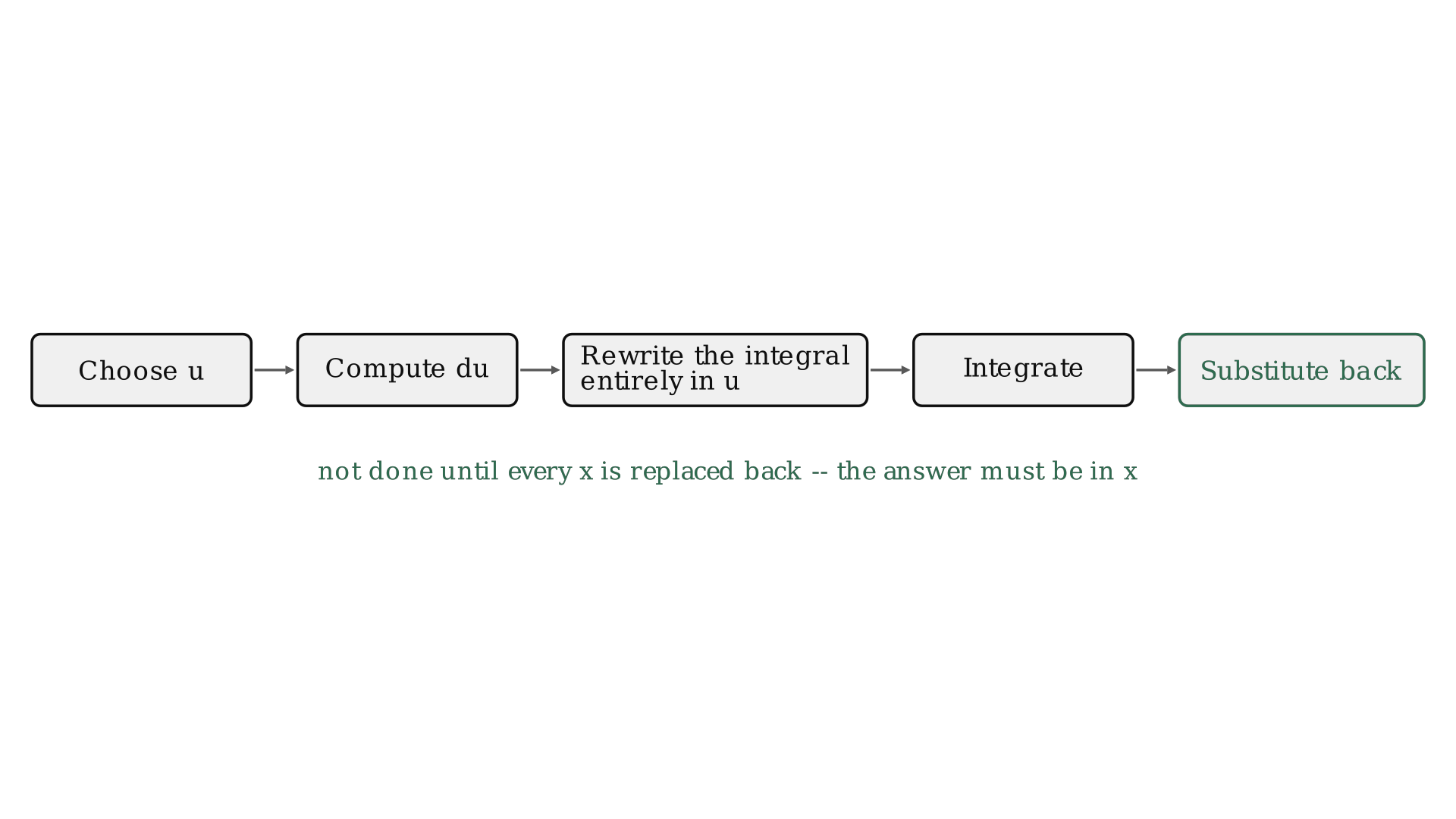
Step 1: Choose $u = g(x)$ (usually the "inside" function).
Step 2: Compute $du = g'(x)\,dx$.
Step 3: Rewrite the entire integral in terms of $u$ and $du$.
Step 4: Integrate with respect to $u$.
Step 5: Substitute back (replace $u$ with $g(x)$), or, for definite integrals, change the limits to $u$-values.
第一步:选 $u = g(x)$(通常是“里层”的函数)。
第二步:算出 $du = g'(x)\,dx$。
第三步:把整个积分都改写成 $u$ 与 $du$。
第四步:对 $u$ 积分。
第五步:把 $u$ 换回 $g(x)$;或者,对定积分,直接把积分上下限换成 $u$ 值。
Worked Example: Indefinite Integral例题:不定积分
Evaluate $\displaystyle\int 2x\cos(x^2)\,dx$.
Let $u = x^2 \;\Longrightarrow\; du = 2x\,dx$ (already present).
$$\begin{aligned} \int 2x\cos(x^2)\,dx &= \int \cos(u)\,du \\[4pt] &= \sin(u) + C \\[4pt] &= \sin(x^2) + C \end{aligned}$$求 $\displaystyle\int 2x\cos(x^2)\,dx$。
令 $u = x^2 \;\Longrightarrow\; du = 2x\,dx$(被积函数里已经有了)。
$$\begin{aligned} \int 2x\cos(x^2)\,dx &= \int \cos(u)\,du \\[4pt] &= \sin(u) + C \\[4pt] &= \sin(x^2) + C \end{aligned}$$Worked Example: Definite Integral (Change Limits)例题:定积分(换上下限)
Evaluate $\displaystyle\int_0^2 x\,e^{x^2}\,dx$.
Let $u = x^2 \;\Longrightarrow\; du = 2x\,dx \;\Longrightarrow\; x\,dx = \frac{du}{2}$. Change limits: $x=0 \to u=0$; $x=2 \to u=4$.
$$\begin{aligned} \int_0^2 x\,e^{x^2}\,dx &= \frac{1}{2}\int_0^4 e^u\,du \\[4pt] &= \frac{1}{2}\bigl[e^u\bigr]_0^4 \\[4pt] &= \frac{1}{2}(e^4 - 1) \end{aligned}$$求 $\displaystyle\int_0^2 x\,e^{x^2}\,dx$。
令 $u = x^2 \;\Longrightarrow\; du = 2x\,dx \;\Longrightarrow\; x\,dx = \frac{du}{2}$。换上下限:$x=0 \to u=0$;$x=2 \to u=4$。
$$\begin{aligned} \int_0^2 x\,e^{x^2}\,dx &= \frac{1}{2}\int_0^4 e^u\,du \\[4pt] &= \frac{1}{2}\bigl[e^u\bigr]_0^4 \\[4pt] &= \frac{1}{2}(e^4 - 1) \end{aligned}$$For $\int_0^1 (1-x)^3\,dx$ with $u=1-x$ we get $du=-dx$ and the limits become $x=0\to u=1$ and $x=1\to u=0$. Writing $-\int_1^0 u^3\,du$ and then dropping the minus sign or forgetting to flip the limits gives $-\tfrac14$. The correct value is $-\int_1^0 u^3\,du=\int_0^1 u^3\,du=\tfrac14$, which must be positive because $(1-x)^3\ge 0$ on $[0,1]$.
对 $\int_0^1 (1-x)^3\,dx$ 取 $u=1-x$,则 $du=-dx$,上下限变为 $x=0\to u=1$,$x=1\to u=0$。若写成 $-\int_1^0 u^3\,du$ 后丢掉负号,或忘了交换上下限,会得到 $-\tfrac14$。正确结果是 $-\int_1^0 u^3\,du=\int_0^1 u^3\,du=\tfrac14$,且必须为正,因为在 $[0,1]$ 上 $(1-x)^3\ge 0$。
On a definite integral, write the new $u$-limits next to the integral sign as soon as you write $du$, or else rewrite the antiderivative in $x$ before substituting the original limits. Then compare the sign of your answer with the sign of the integrand on the interval.
对定积分,一写出 $du$ 就把新的 $u$ 上下限标在积分号旁边;否则就先把原函数换回 $x$,再代入原来的上下限。最后把答案的符号与被积函数在该区间上的符号对照一下。
Find $\int x(x^2+1)^4\,dx$.求 $\int x(x^2+1)^4\,dx$。
$u=x^2+1$, $du=2x\,dx$: $\tfrac12\int u^4\,du=\dfrac{u^5}{10}+C=\dfrac{(x^2+1)^5}{10}+C$.
$u=x^2+1$,$du=2x\,dx$:$\tfrac12\int u^4\,du=\dfrac{u^5}{10}+C=\dfrac{(x^2+1)^5}{10}+C$。
Evaluate $\int_0^{\pi/2} \sin x\cos x\,dx$.求 $\int_0^{\pi/2} \sin x\cos x\,dx$。
$u=\sin x$, $du=\cos x\,dx$; $x=0\to u=0$, $x=\pi/2\to u=1$: $\int_0^1 u\,du=\tfrac12$.
$u=\sin x$,$du=\cos x\,dx$;$x=0\to u=0$,$x=\pi/2\to u=1$:$\int_0^1 u\,du=\tfrac12$。
Find $\int e^{3x}\,dx$.求 $\int e^{3x}\,dx$。
$u=3x$, $du=3\,dx$: $\tfrac13\int e^u\,du=\tfrac13 e^{3x}+C$.
$u=3x$,$du=3\,dx$:$\tfrac13\int e^u\,du=\tfrac13 e^{3x}+C$。
Integrating Using Long Division & Completing the Square
用多项式长除法与配方法积分
- Determine when long division is needed (degree of numerator $\ge$ degree of denominator).
- Calculate the quotient and remainder and integrate each part.
- Complete the square in a quadratic denominator.
- Calculate integrals of the form $\int \frac{du}{u^2+a^2}$ with the $\arctan$ rule.
- Choose between long division and completing the square from the form of the integrand.
- 判断何时需要长除法(分子次数 $\ge$ 分母次数)。
- 求出商与余式并分别积分。
- 对二次分母配方。
- 用 $\arctan$ 公式计算形如 $\int \frac{du}{u^2+a^2}$ 的积分。
- 根据被积函数的形式选择长除法或配方法。
Some rational integrands need algebraic manipulation before you can integrate.
有些有理函数被积式需要先做代数变形才能积分。
Long Division
多项式长除法
long division)。先做除法,再对得到的多项式部分 + 余式分式分别积分。
Worked Example: Long Division例题:多项式长除法
Evaluate $\displaystyle\int \frac{x^2 + 3}{x - 1}\,dx$.
Long division: $x^2 + 3 = (x-1)(x+1) + 4$, so:
$$\frac{x^2+3}{x-1} = x + 1 + \frac{4}{x-1}$$ $$\begin{aligned} \int \frac{x^2+3}{x-1}\,dx &= \int\!\left(x + 1 + \frac{4}{x-1}\right)dx \\[4pt] &= \frac{x^2}{2} + x + 4\ln|x-1| + C \end{aligned}$$求 $\displaystyle\int \frac{x^2 + 3}{x - 1}\,dx$。
长除法:$x^2 + 3 = (x-1)(x+1) + 4$,所以:
$$\frac{x^2+3}{x-1} = x + 1 + \frac{4}{x-1}$$ $$\begin{aligned} \int \frac{x^2+3}{x-1}\,dx &= \int\!\left(x + 1 + \frac{4}{x-1}\right)dx \\[4pt] &= \frac{x^2}{2} + x + 4\ln|x-1| + C \end{aligned}$$Completing the Square
配方法
Worked Example: Completing the Square例题:配方法
Evaluate $\displaystyle\int \frac{1}{x^2 + 4x + 13}\,dx$.
Complete the square: $x^2 + 4x + 13 = (x+2)^2 + 9$.
This matches $\displaystyle\int \frac{du}{u^2+a^2} = \frac{1}{a}\arctan\!\left(\frac{u}{a}\right)+C$ with $u = x+2$, $a = 3$:
$$= \frac{1}{3}\arctan\!\left(\frac{x+2}{3}\right) + C$$求 $\displaystyle\int \frac{1}{x^2 + 4x + 13}\,dx$。
配方:$x^2 + 4x + 13 = (x+2)^2 + 9$。
对应公式 $\displaystyle\int \frac{du}{u^2+a^2} = \frac{1}{a}\arctan\!\left(\frac{u}{a}\right)+C$,取 $u = x+2$,$a = 3$:
$$= \frac{1}{3}\arctan\!\left(\frac{x+2}{3}\right) + C$$After completing the square, write down $u$ and $a$ explicitly before using $\int\frac{du}{u^2+a^2}=\frac1a\arctan\frac ua+C$; the $\frac1a$ factor is the piece most often dropped. After long division, check the quotient by multiplying back: (divisor) $\times$ (quotient) $+$ (remainder) must give the numerator.
配方之后,先明确写出 $u$ 和 $a$,再用 $\int\frac{du}{u^2+a^2}=\frac1a\arctan\frac ua+C$;$\frac1a$ 这个因子最容易漏掉。长除法之后,乘回去检验商:(除式)$\times$(商)$+$(余式)必须等于分子。
Find $\int \dfrac{x^2}{x+1}\,dx$.求 $\int \dfrac{x^2}{x+1}\,dx$。
$x^2=(x+1)(x-1)+1$, so the integrand is $x-1+\dfrac{1}{x+1}$ and the integral is $\dfrac{x^2}{2}-x+\ln|x+1|+C$.
$x^2=(x+1)(x-1)+1$,所以被积函数为 $x-1+\dfrac{1}{x+1}$,积分为 $\dfrac{x^2}{2}-x+\ln|x+1|+C$。
Find $\int \dfrac{1}{x^2+2x+2}\,dx$.求 $\int \dfrac{1}{x^2+2x+2}\,dx$。
$x^2+2x+2=(x+1)^2+1$, so $u=x+1$, $a=1$: $\arctan(x+1)+C$.
$x^2+2x+2=(x+1)^2+1$,所以 $u=x+1$,$a=1$:$\arctan(x+1)+C$。
Find $\int \dfrac{1}{\sqrt{2x-x^2}}\,dx$.求 $\int \dfrac{1}{\sqrt{2x-x^2}}\,dx$。
$2x-x^2=1-(x-1)^2$, so with $u=x-1$ this is $\int\frac{du}{\sqrt{1-u^2}}=\arcsin(x-1)+C$.
$2x-x^2=1-(x-1)^2$,令 $u=x-1$,得 $\int\frac{du}{\sqrt{1-u^2}}=\arcsin(x-1)+C$。
Integrating Using Integration by Parts (BC)
用分部积分法(BC)
- State the integration by parts formula and explain how it comes from the product rule.
- Choose $u$ and $dv$ using the LIATE order.
- Calculate integrals such as $\int x e^x\,dx$ and $\int \ln x\,dx$.
- Apply the tabular method to repeated integration by parts.
- Evaluate definite integrals by parts with $\bigl[uv\bigr]_a^b$.
- 陈述分部积分公式,并解释它如何由乘积法则得到。
- 按 LIATE 顺序选择 $u$ 和 $dv$。
- 计算 $\int x e^x\,dx$ 和 $\int \ln x\,dx$ 等积分。
- 用表格法处理多次分部积分。
- 用 $\bigl[uv\bigr]_a^b$ 计算定积分的分部积分。
integration by parts)Worked Example: Integration by Parts例题:分部积分法
Evaluate $\displaystyle\int x\,e^x\,dx$.
Choose by LIATE: $u = x,\; dv = e^x\,dx \;\Longrightarrow\; du = dx,\; v = e^x$.
$$\begin{aligned} \int x\,e^x\,dx &= x\,e^x - \int e^x\,dx \\[4pt] &= x\,e^x - e^x + C \\[4pt] &= e^x(x - 1) + C \end{aligned}$$求 $\displaystyle\int x\,e^x\,dx$。
按 LIATE 选:$u = x,\; dv = e^x\,dx \;\Longrightarrow\; du = dx,\; v = e^x$。
$$\begin{aligned} \int x\,e^x\,dx &= x\,e^x - \int e^x\,dx \\[4pt] &= x\,e^x - e^x + C \\[4pt] &= e^x(x - 1) + C \end{aligned}$$Worked Example: Tabular Method例题:表格法
Evaluate $\displaystyle\int x^2 \sin x\,dx$ using the tabular method.
Differentiate $x^2$ repeatedly down one column; integrate $\sin x$ repeatedly down the other, until the $D$-column reaches $0$:
$$\begin{array}{c|c|c} \text{Sign} & D & I \\ \hline + & x^2 & \sin x \\ - & 2x & -\cos x \\ + & 2 & -\sin x \\ - & 0 & \cos x \end{array}$$Multiply diagonally with the alternating signs and sum:
$$\int x^2\sin x\,dx = -x^2\cos x + 2x\sin x + 2\cos x + C$$用表格法求 $\displaystyle\int x^2 \sin x\,dx$。
一列反复对 $x^2$ 求导,另一列反复对 $\sin x$ 积分,直到 $D$ 列变为 $0$:
$$\begin{array}{c|c|c} \text{符号} & D & I \\ \hline + & x^2 & \sin x \\ - & 2x & -\cos x \\ + & 2 & -\sin x \\ - & 0 & \cos x \end{array}$$按交替符号对角相乘并求和:
$$\int x^2\sin x\,dx = -x^2\cos x + 2x\sin x + 2\cos x + C$$Write $u$, $dv$, $du$ and $v$ in a small block before substituting into $uv-\int v\,du$. On a definite integral, the $uv$ term is evaluated at the limits too: $\int_a^b u\,dv=\bigl[uv\bigr]_a^b-\int_a^b v\,du$.
代入 $uv-\int v\,du$ 之前,先在一个小框里写出 $u$、$dv$、$du$ 和 $v$。对定积分,$uv$ 项也要在上下限处求值:$\int_a^b u\,dv=\bigl[uv\bigr]_a^b-\int_a^b v\,du$。
Find $\int \ln x\,dx$.求 $\int \ln x\,dx$。
$u=\ln x$, $dv=dx$, $du=\frac{1}{x}dx$, $v=x$: $x\ln x-\int 1\,dx=x\ln x-x+C$.
$u=\ln x$,$dv=dx$,$du=\frac{1}{x}dx$,$v=x$:$x\ln x-\int 1\,dx=x\ln x-x+C$。
Evaluate $\int_0^1 x e^x\,dx$.求 $\int_0^1 x e^x\,dx$。
Using $\int x e^x\,dx=e^x(x-1)+C$: $\bigl[e^x(x-1)\bigr]_0^1=0-(-1)=1$.
利用 $\int x e^x\,dx=e^x(x-1)+C$:$\bigl[e^x(x-1)\bigr]_0^1=0-(-1)=1$。
Find $\int x\cos x\,dx$, naming your choice of $u$.求 $\int x\cos x\,dx$,并说明 $u$ 的选择。
Algebraic before trig: $u=x$, $dv=\cos x\,dx$, $v=\sin x$. Result: $x\sin x-\int\sin x\,dx=x\sin x+\cos x+C$.
代数函数优先于三角函数:$u=x$,$dv=\cos x\,dx$,$v=\sin x$。结果:$x\sin x-\int\sin x\,dx=x\sin x+\cos x+C$。
Integrating Using Linear Partial Fractions (BC)
用一次因式的部分分式积分(BC)
- Determine whether a rational integrand is proper, and long-divide first if it is not.
- Factor the denominator into distinct linear factors.
- Calculate the constants $A$ and $B$ by substituting the roots.
- Calculate the resulting logarithmic antiderivatives.
- Evaluate a definite integral by partial fractions and simplify with log laws.
- 判断有理被积函数是否为真分式,若不是先做长除法。
- 把分母分解为互不相同的一次因式。
- 代入根求出常数 $A$ 和 $B$。
- 求出得到的对数型原函数。
- 用部分分式计算定积分,并用对数法则化简。
partial fractions)。
Worked Example: Long Division First, Then Decompose例题:先做长除法,再分解
Evaluate $\displaystyle\int \frac{x^2 + 1}{x - 2}\,dx$. Note $\deg(\text{num}) = 2 \ge 1 = \deg(\text{denom})$, so it is improper. Long-divide first.
Step 1: Polynomial long division of $x^2 + 1$ by $x - 2$.
- $x^2 \div x = x$. Multiply: $x(x-2) = x^2 - 2x$. Subtract: $(x^2 + 1) - (x^2 - 2x) = 2x + 1$.
- $2x \div x = 2$. Multiply: $2(x-2) = 2x - 4$. Subtract: $(2x + 1) - (2x - 4) = 5$.
So
$$\frac{x^2 + 1}{x - 2} \;=\; x + 2 + \frac{5}{x - 2}.$$The remainder $\dfrac{5}{x - 2}$ is now proper (numerator degree $0 < 1$).
Step 2: Integrate term by term. The remainder is already a single linear factor; no further partial-fraction decomposition needed:
$$\begin{aligned} \int \frac{x^2 + 1}{x - 2}\,dx &= \int \!\bigl(x + 2 + \tfrac{5}{x - 2}\bigr)\,dx \\[4pt] &= \frac{x^2}{2} + 2x + 5\ln|x - 2| + C. \end{aligned}$$求 $\displaystyle\int \frac{x^2 + 1}{x - 2}\,dx$。注意 $\deg(\text{num}) = 2 \ge 1 = \deg(\text{denom})$,是假分式。先做长除法。
第一步:用 $x^2 + 1$ 除以 $x - 2$ 做多项式长除法。
- $x^2 \div x = x$。 乘回:$x(x-2) = x^2 - 2x$。 相减:$(x^2 + 1) - (x^2 - 2x) = 2x + 1$。
- $2x \div x = 2$。 乘回:$2(x-2) = 2x - 4$。 相减:$(2x + 1) - (2x - 4) = 5$。
因此
$$\frac{x^2 + 1}{x - 2} \;=\; x + 2 + \frac{5}{x - 2}.$$余项 $\dfrac{5}{x - 2}$ 现在是真分式(分子次数 $0 < 1$)。
第二步:逐项积分。余项已经是单个一次因式,不再需要部分分式分解:
$$\begin{aligned} \int \frac{x^2 + 1}{x - 2}\,dx &= \int \!\bigl(x + 2 + \tfrac{5}{x - 2}\bigr)\,dx \\[4pt] &= \frac{x^2}{2} + 2x + 5\ln|x - 2| + C. \end{aligned}$$Partial-fraction decomposition assumes the rational expression behaves like a sum of $\dfrac{A}{x-a}$ pieces (each of which has lower-degree numerator). If you skip the long division, you're trying to decompose a function that has a polynomial growth term, and the system $A = \cdots$ won't have a consistent solution.
部分分式分解的前提是这个有理式可以写成若干 $\dfrac{A}{x-a}$ 之和(每一项的分子次数都更低)。若跳过长除法,你实际上是在试图分解一个还带有多项式增长项的函数,求 $A = \cdots$ 的方程组就不会有相容解。
Worked Example: Partial Fractions例题:部分分式
Evaluate $\displaystyle\int \frac{5}{x^2 - x - 6}\,dx$.
Factor: $x^2 - x - 6 = (x-3)(x+2)$. Set up partial fractions:
$$\frac{5}{(x-3)(x+2)} = \frac{A}{x-3} + \frac{B}{x+2}$$Multiply through: $5 = A(x+2) + B(x-3)$.
$$x=3:\; 5 = 5A \;\Longrightarrow\; A = 1 \qquad x=-2:\; 5 = -5B \;\Longrightarrow\; B = -1$$ $$\begin{aligned} \int \frac{5}{x^2-x-6}\,dx &= \int\!\left(\frac{1}{x-3} - \frac{1}{x+2}\right)dx \\[4pt] &= \ln|x-3| - \ln|x+2| + C \end{aligned}$$求 $\displaystyle\int \frac{5}{x^2 - x - 6}\,dx$。
分解:$x^2 - x - 6 = (x-3)(x+2)$。设部分分式:
$$\frac{5}{(x-3)(x+2)} = \frac{A}{x-3} + \frac{B}{x+2}$$两边乘上分母:$5 = A(x+2) + B(x-3)$。
$$x=3:\; 5 = 5A \;\Longrightarrow\; A = 1 \qquad x=-2:\; 5 = -5B \;\Longrightarrow\; B = -1$$ $$\begin{aligned} \int \frac{5}{x^2-x-6}\,dx &= \int\!\left(\frac{1}{x-3} - \frac{1}{x+2}\right)dx \\[4pt] &= \ln|x-3| - \ln|x+2| + C \end{aligned}$$Check $A$ and $B$ by recombining the fractions over the common denominator before integrating. Keep the absolute values in $\ln|x-a|$, and combine logs only after the antiderivative is complete.
积分前,把分式通分合并回去检验 $A$ 和 $B$。保留 $\ln|x-a|$ 中的绝对值,并在原函数写完之后再合并对数。
Find $\int \dfrac{1}{x(x+1)}\,dx$.求 $\int \dfrac{1}{x(x+1)}\,dx$。
$1=A(x+1)+Bx$: $x=0$ gives $A=1$, $x=-1$ gives $B=-1$. Result: $\ln|x|-\ln|x+1|+C$.
$1=A(x+1)+Bx$:$x=0$ 得 $A=1$,$x=-1$ 得 $B=-1$。结果:$\ln|x|-\ln|x+1|+C$。
Find $\int \dfrac{3x+1}{(x-1)(x+1)}\,dx$.求 $\int \dfrac{3x+1}{(x-1)(x+1)}\,dx$。
$3x+1=A(x+1)+B(x-1)$: $x=1$ gives $4=2A$, $A=2$; $x=-1$ gives $-2=-2B$, $B=1$. Result: $2\ln|x-1|+\ln|x+1|+C$.
$3x+1=A(x+1)+B(x-1)$:$x=1$ 得 $4=2A$,$A=2$;$x=-1$ 得 $-2=-2B$,$B=1$。结果:$2\ln|x-1|+\ln|x+1|+C$。
Evaluate $\int_2^3 \dfrac{1}{x^2-1}\,dx$.求 $\int_2^3 \dfrac{1}{x^2-1}\,dx$。
$\dfrac{1}{(x-1)(x+1)}=\tfrac12\left(\dfrac{1}{x-1}-\dfrac{1}{x+1}\right)$, so the value is $\tfrac12\bigl[\ln|x-1|-\ln|x+1|\bigr]_2^3=\tfrac12\bigl[(\ln 2-\ln 4)-(\ln 1-\ln 3)\bigr]=\tfrac12\ln\tfrac32\approx 0.203$.
$\dfrac{1}{(x-1)(x+1)}=\tfrac12\left(\dfrac{1}{x-1}-\dfrac{1}{x+1}\right)$,所以值为 $\tfrac12\bigl[\ln|x-1|-\ln|x+1|\bigr]_2^3=\tfrac12\bigl[(\ln 2-\ln 4)-(\ln 1-\ln 3)\bigr]=\tfrac12\ln\tfrac32\approx 0.203$。
Evaluating Improper Integrals (BC)
计算反常积分(BC)
- Identify the two kinds of improper integral: infinite limits and unbounded integrands.
- Express an improper integral as a limit of proper integrals.
- Evaluate a convergent improper integral and state its value.
- Determine that an improper integral diverges and state why.
- Apply the $p$-test for $\int_1^{\infty}\frac{1}{x^p}\,dx$ and split at an interior discontinuity.
- 识别两类反常积分:无穷积分限与无界被积函数。
- 把反常积分表示为普通积分的极限。
- 计算收敛的反常积分并写出其值。
- 判断反常积分发散并说明原因。
- 对 $\int_1^{\infty}\frac{1}{x^p}\,dx$ 使用 $p$ 判别法,并在内部间断点处拆分。
Case 1: Infinite Limits of Integration
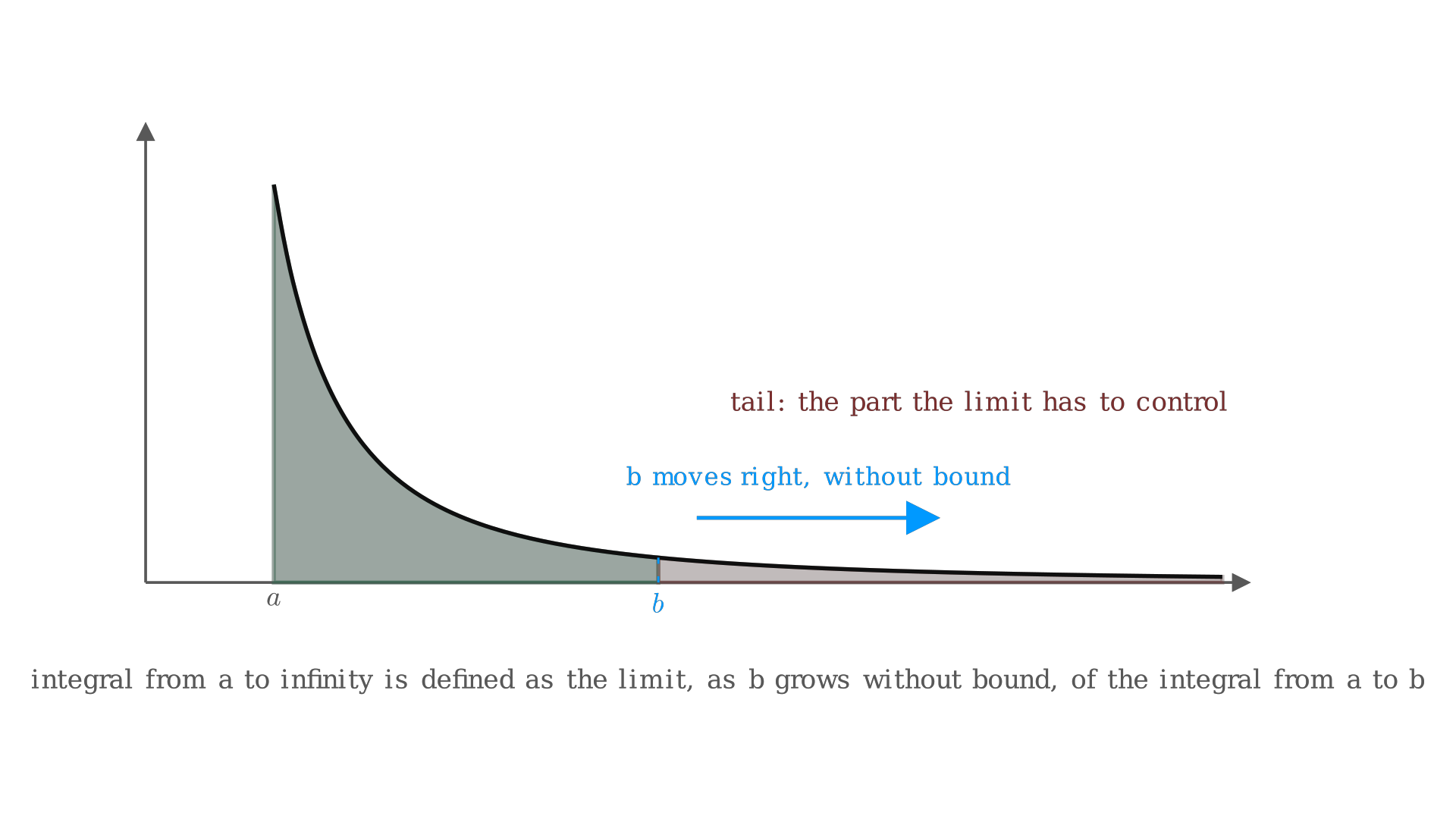
情形 1:积分上下限为无穷
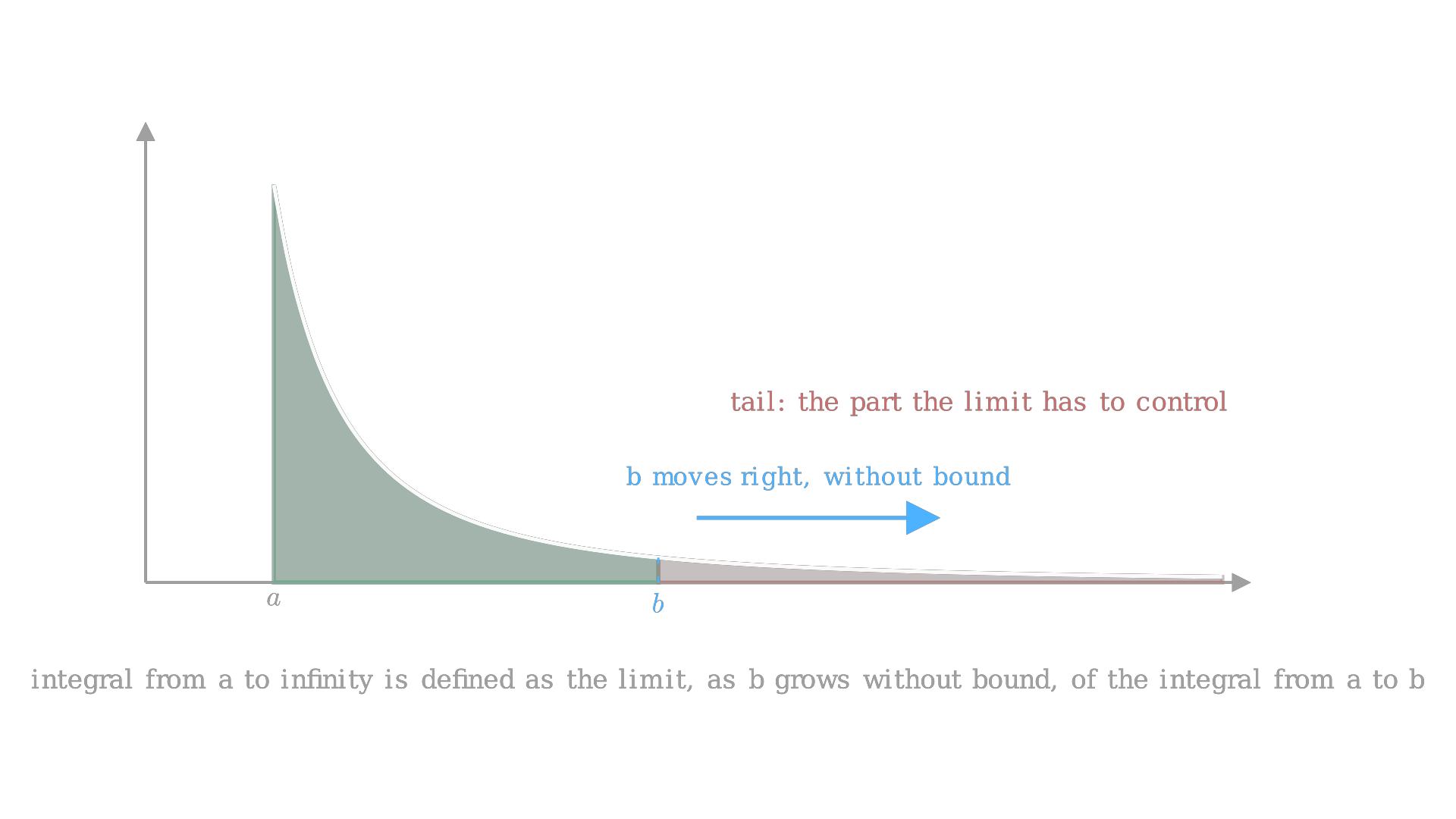
improper integral):无穷上限If the limit exists and is finite, the integral converges. If the limit is infinite or does not exist, the integral diverges.
如果该极限存在且有限,则积分收敛(converges)。如果该极限为无穷或不存在,则积分发散(diverges)。
Worked Example: Convergent Improper Integral例题:收敛的反常积分
Evaluate $\displaystyle\int_1^{\infty} \frac{1}{x^2}\,dx$.
$$\begin{aligned} &= \lim_{b \to \infty} \int_1^b x^{-2}\,dx \\[4pt] &= \lim_{b \to \infty} \bigl[-x^{-1}\bigr]_1^b \\[4pt] &= \lim_{b \to \infty} \left(-\frac{1}{b} + 1\right) \\[4pt] &= 0 + 1 = 1 \end{aligned}$$The integral converges to $1$.
求 $\displaystyle\int_1^{\infty} \frac{1}{x^2}\,dx$。
$$\begin{aligned} &= \lim_{b \to \infty} \int_1^b x^{-2}\,dx \\[4pt] &= \lim_{b \to \infty} \bigl[-x^{-1}\bigr]_1^b \\[4pt] &= \lim_{b \to \infty} \left(-\frac{1}{b} + 1\right) \\[4pt] &= 0 + 1 = 1 \end{aligned}$$该积分收敛于 $1$。
Worked Example: Divergent Improper Integral例题:发散的反常积分
Evaluate $\displaystyle\int_1^{\infty} \frac{1}{x}\,dx$.
$$\begin{aligned} &= \lim_{b \to \infty} \int_1^b \frac{1}{x}\,dx \\[4pt] &= \lim_{b \to \infty} \bigl[\ln|x|\bigr]_1^b \\[4pt] &= \lim_{b \to \infty} (\ln b - \ln 1) \\[4pt] &= \lim_{b \to \infty} \ln b = \infty \end{aligned}$$The integral diverges.
求 $\displaystyle\int_1^{\infty} \frac{1}{x}\,dx$。
$$\begin{aligned} &= \lim_{b \to \infty} \int_1^b \frac{1}{x}\,dx \\[4pt] &= \lim_{b \to \infty} \bigl[\ln|x|\bigr]_1^b \\[4pt] &= \lim_{b \to \infty} (\ln b - \ln 1) \\[4pt] &= \lim_{b \to \infty} \ln b = \infty \end{aligned}$$该积分发散。
Case 2: Discontinuity Inside the Interval
情形 2:区间内部存在间断点
If the integrand has a vertical asymptote at an interior point $c$ with $a \lt c \lt b$, the integral is improper at $c$ and you must split it at the discontinuity before evaluating. Each piece becomes a one-sided limit.
若被积函数在内部某点 $c$(满足 $a \lt c \lt b$)有垂直渐近线,则该积分在 $c$ 处是反常的,计算前必须在该间断点处拆开。每一段都写成一个单侧极限。
The full integral converges only if both one-sided pieces converge. If either piece diverges, the whole integral diverges.
只有两段单侧极限都收敛,整体积分才收敛。任一段发散,整体就发散。
Worked Example: Splitting at an Interior Discontinuity ($\displaystyle\int_0^{2}\frac{1}{(x-1)^{1/3}}\,dx$)例题:在内部间断点处拆分($\displaystyle\int_0^{2}\frac{1}{(x-1)^{1/3}}\,dx$)
Step 1: Locate the discontinuity. The integrand $(x-1)^{-1/3}$ blows up as $x \to 1$. Since $0 \lt 1 \lt 2$, this is an interior singularity, so split at $x=1$:
$$ \int_0^{2}(x-1)^{-1/3}\,dx \;=\; \underbrace{\lim_{t\to 1^{-}}\int_0^{t}(x-1)^{-1/3}\,dx}_{\text{A}} \;+\; \underbrace{\lim_{s\to 1^{+}}\int_{s}^{2}(x-1)^{-1/3}\,dx}_{\text{B}} $$Step 2: Antiderivative. Using $u = x-1$, $du = dx$:
$$ \int (x-1)^{-1/3}\,dx \;=\; \tfrac{3}{2}\,(x-1)^{2/3} + C $$Step 3: Evaluate Piece A.
$$\begin{aligned} \lim_{t\to 1^{-}} \tfrac{3}{2}(x-1)^{2/3}\Big|_0^{t} &= \lim_{t\to 1^{-}}\!\left[\tfrac{3}{2}(t-1)^{2/3} - \tfrac{3}{2}(-1)^{2/3}\right] \\[4pt] &= 0 - \tfrac{3}{2}(1) \;=\; -\tfrac{3}{2} \end{aligned}$$(Note: $(-1)^{2/3} = \bigl((-1)^2\bigr)^{1/3} = 1$, and $(t-1)^{2/3} \to 0$ since $2/3 \gt 0$.)
Step 4: Evaluate Piece B.
$$\begin{aligned} \lim_{s\to 1^{+}} \tfrac{3}{2}(x-1)^{2/3}\Big|_s^{2} &= \lim_{s\to 1^{+}}\!\left[\tfrac{3}{2}(1)^{2/3} - \tfrac{3}{2}(s-1)^{2/3}\right] \\[4pt] &= \tfrac{3}{2} - 0 \;=\; \tfrac{3}{2} \end{aligned}$$Step 5: Add the pieces. Both are finite, so the original integral converges:
$$ \int_0^{2}(x-1)^{-1/3}\,dx \;=\; -\tfrac{3}{2} + \tfrac{3}{2} \;=\; 0 $$Sanity check. The integrand is an odd function about $x=1$, so by symmetry the signed area on $[0,1]$ exactly cancels the signed area on $[1,2]$. The answer of $0$ matches that intuition.
第一步:找到间断点。被积函数 $(x-1)^{-1/3}$ 在 $x \to 1$ 时趋向无穷。由于 $0 \lt 1 \lt 2$,这是内部奇点,在 $x=1$ 处拆开:
$$ \int_0^{2}(x-1)^{-1/3}\,dx \;=\; \underbrace{\lim_{t\to 1^{-}}\int_0^{t}(x-1)^{-1/3}\,dx}_{\text{A}} \;+\; \underbrace{\lim_{s\to 1^{+}}\int_{s}^{2}(x-1)^{-1/3}\,dx}_{\text{B}} $$第二步:求原函数。令 $u = x-1$,$du = dx$:
$$ \int (x-1)^{-1/3}\,dx \;=\; \tfrac{3}{2}\,(x-1)^{2/3} + C $$第三步:算 A 段。
$$\begin{aligned} \lim_{t\to 1^{-}} \tfrac{3}{2}(x-1)^{2/3}\Big|_0^{t} &= \lim_{t\to 1^{-}}\!\left[\tfrac{3}{2}(t-1)^{2/3} - \tfrac{3}{2}(-1)^{2/3}\right] \\[4pt] &= 0 - \tfrac{3}{2}(1) \;=\; -\tfrac{3}{2} \end{aligned}$$(注意:$(-1)^{2/3} = \bigl((-1)^2\bigr)^{1/3} = 1$;因 $2/3 \gt 0$,$(t-1)^{2/3} \to 0$。)
第四步:算 B 段。
$$\begin{aligned} \lim_{s\to 1^{+}} \tfrac{3}{2}(x-1)^{2/3}\Big|_s^{2} &= \lim_{s\to 1^{+}}\!\left[\tfrac{3}{2}(1)^{2/3} - \tfrac{3}{2}(s-1)^{2/3}\right] \\[4pt] &= \tfrac{3}{2} - 0 \;=\; \tfrac{3}{2} \end{aligned}$$第五步:把两段加起来。两段都是有限值,故原积分收敛:
$$ \int_0^{2}(x-1)^{-1/3}\,dx \;=\; -\tfrac{3}{2} + \tfrac{3}{2} \;=\; 0 $$核对一下。被积函数关于 $x=1$ 是奇函数,由对称性,$[0,1]$ 上的有符号面积正好抵消 $[1,2]$ 上的有符号面积。答案 $0$ 与直觉吻合。
Write the limit explicitly, e.g. $\lim_{b\to\infty}\int_1^b$, before evaluating; substituting $\infty$ as if it were a number is an incomplete setup. End with a clear conclusion: "converges to $1$" or "diverges".
计算前明确写出极限,例如 $\lim_{b\to\infty}\int_1^b$;把 $\infty$ 当作数直接代入是不完整的写法。最后给出明确结论:“收敛于 $1$”或“发散”。
Evaluate $\int_0^{\infty} e^{-x}\,dx$.求 $\int_0^{\infty} e^{-x}\,dx$。
$\lim_{b\to\infty}\bigl[-e^{-x}\bigr]_0^b=\lim_{b\to\infty}\left(1-e^{-b}\right)=1$. It converges to $1$.
$\lim_{b\to\infty}\bigl[-e^{-x}\bigr]_0^b=\lim_{b\to\infty}\left(1-e^{-b}\right)=1$。收敛于 $1$。
Evaluate $\int_0^{1} \dfrac{1}{\sqrt{x}}\,dx$.求 $\int_0^{1} \dfrac{1}{\sqrt{x}}\,dx$。
The integrand is unbounded at $x=0$: $\lim_{t\to 0^+}\bigl[2\sqrt{x}\bigr]_t^1=\lim_{t\to 0^+}\left(2-2\sqrt{t}\right)=2$. It converges to $2$.
被积函数在 $x=0$ 处无界:$\lim_{t\to 0^+}\bigl[2\sqrt{x}\bigr]_t^1=\lim_{t\to 0^+}\left(2-2\sqrt{t}\right)=2$。收敛于 $2$。
Does $\int_0^{1} \dfrac{1}{x}\,dx$ converge?$\int_0^{1} \dfrac{1}{x}\,dx$ 收敛吗?
No. $\lim_{t\to 0^+}\bigl[\ln x\bigr]_t^1=\lim_{t\to 0^+}(0-\ln t)=\infty$, so it diverges.
不收敛。$\lim_{t\to 0^+}\bigl[\ln x\bigr]_t^1=\lim_{t\to 0^+}(0-\ln t)=\infty$,所以发散。
Selecting Techniques for Antidifferentiation
选择求原函数的方法
- Identify the form of an integrand: basic rule, composition, product, or rational function.
- Choose the simplest technique that applies, trying algebra before substitution.
- Distinguish integrands that need $u$-substitution from those that need another method.
- Calculate integrals that need a combination of techniques.
- Recognize when a technique is BC-only (integration by parts, partial fractions).
- 识别被积函数的形式:基本公式、复合、乘积或有理函数。
- 选择适用的最简单方法,先试代数变形再试代换。
- 区分需要 $u$ 代换的被积函数与需要其他方法的被积函数。
- 计算需要组合多种方法的积分。
- 识别哪些方法仅属 BC(分部积分、部分分式)。
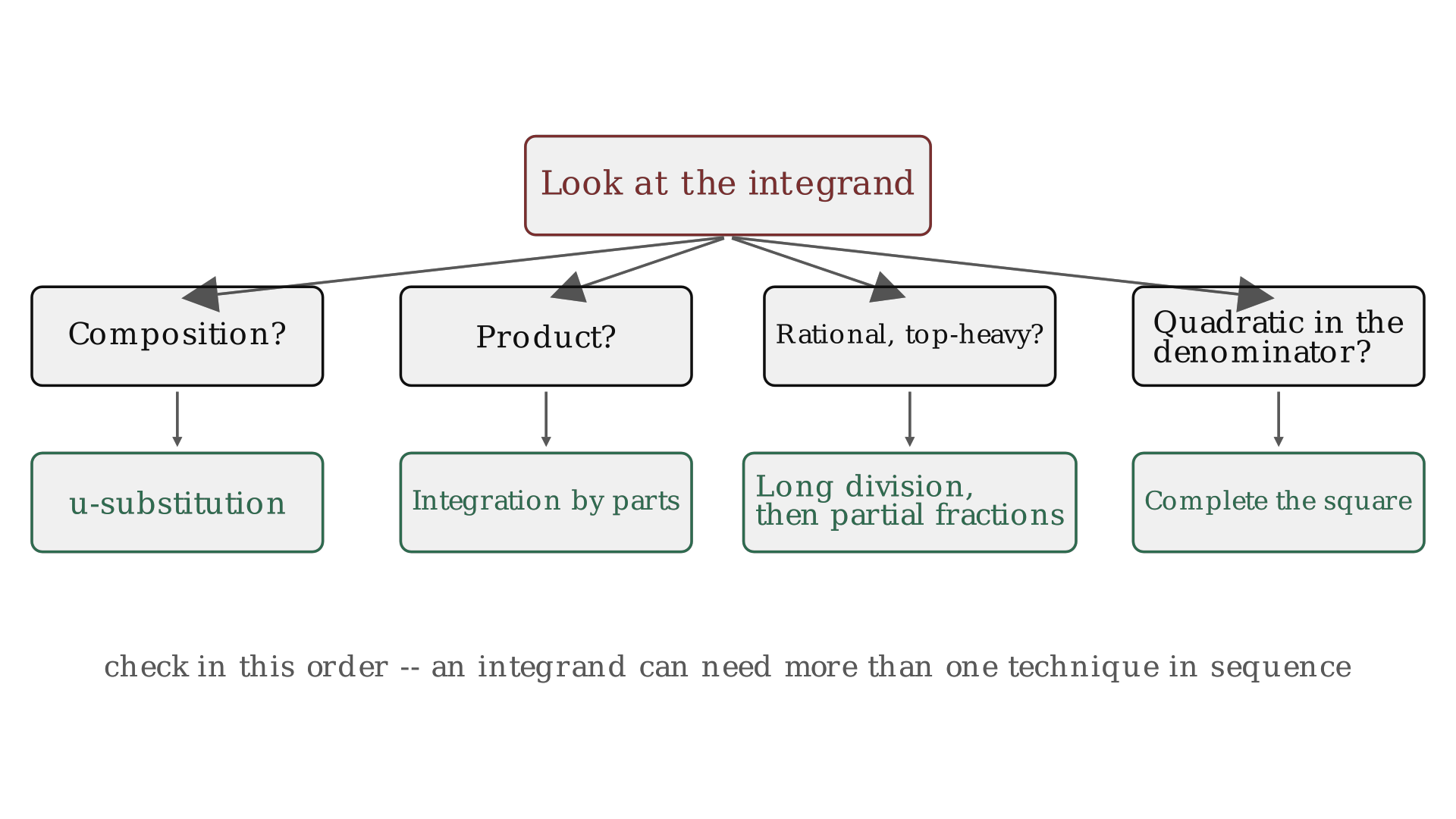
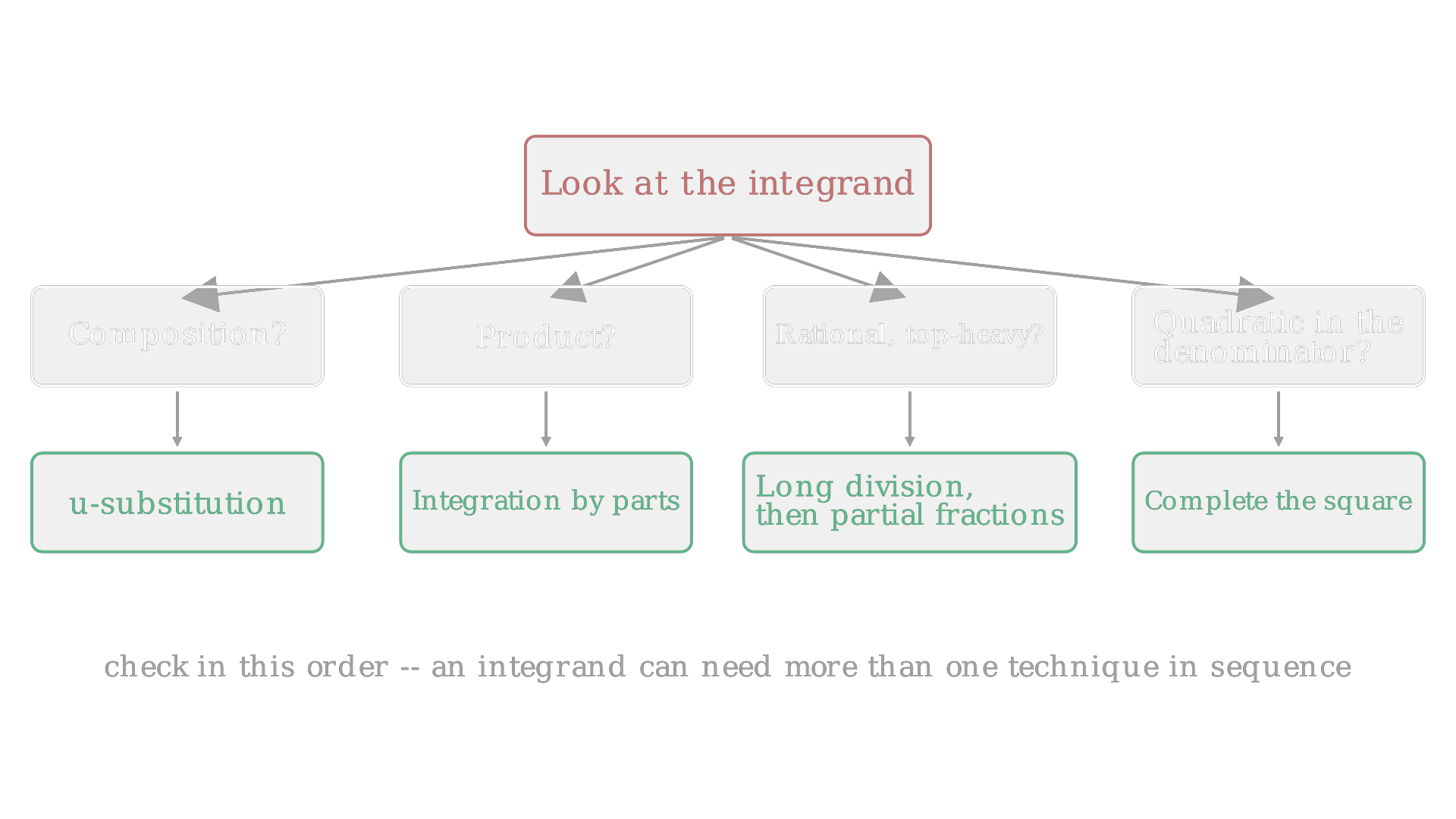
On the AP exam, you must quickly identify which technique to use. Here's a decision flowchart:
AP 考试中,你必须迅速判断该用哪种方法。下面是决策流程:
1. Basic rule? Check if the integrand matches a known antiderivative directly.
2. Algebraic simplification? Can you expand, factor, simplify, or split a fraction first?
3. U-substitution? Do you see a composite function with its derivative present (or nearly present)?
4. Long division? Is the numerator's degree ≥ the denominator's degree?
5. Completing the square? Irreducible quadratic in the denominator → $\arctan$ or $\arcsin$?
6. Integration by parts? BC Product of two different "types" (e.g., polynomial × exponential)?
7. Partial fractions? BC Proper fraction with factorable denominator?
1. 基本公式?看看被积函数是不是直接匹配一个已知原函数。
2. 代数化简?能不能先展开、因式分解、化简或拆分分式?
3. u 代换?是否看到一个复合函数,并且它的导数也(差不多)出现在被积式里?
4. 多项式长除法?分子次数是否 ≥ 分母次数?
5. 配方法?分母是不可分解的二次式 → $\arctan$ 或 $\arcsin$ 形式?
6. 分部积分? BC 两种不同“类型”的乘积(例如多项式 × 指数)?
7. 部分分式? BC 分母可因式分解的真分式?
Worked Example: Resisting the Urge to u-Sub例题:克制住立刻 u 代换的冲动
Evaluate $\displaystyle\int \frac{x+1}{x}\,dx$.
Tempting but unnecessary: the fraction looks like it might need $u$-substitution or long division. Checking the flowchart in order, Step 2 (algebraic simplification) applies first: split the fraction.
$$\frac{x+1}{x} = \frac{x}{x} + \frac{1}{x} = 1 + \frac{1}{x}$$Now Step 1 (basic rules) finishes it off directly:
$$\int \left(1 + \frac{1}{x}\right) dx = x + \ln|x| + C$$No substitution, no division algorithm, just the "simplest technique first" habit.
求 $\displaystyle\int \frac{x+1}{x}\,dx$。
看似需要更复杂的方法:这个分式看起来可能需要 $u$ 代换或长除法。但按流程图顺序检查,第 2 步(代数化简)先适用:拆分分式。
$$\frac{x+1}{x} = \frac{x}{x} + \frac{1}{x} = 1 + \frac{1}{x}$$接下来第 1 步(基本公式)就能直接收尾:
$$\int \left(1 + \frac{1}{x}\right) dx = x + \ln|x| + C$$不需要代换,也不需要除法算法,只是"先试最简单方法"的习惯。
Worked Example: Same Look, Different Technique例题:形式相似,方法不同
Evaluate $\displaystyle\int \frac{x}{x^2+1}\,dx$, $\displaystyle\int \frac{1}{x^2+1}\,dx$ and $\displaystyle\int \frac{x^2}{x^2+1}\,dx$.
First: the derivative of $x^2+1$ is $2x$, which is present up to a constant, so $u=x^2+1$: $\tfrac12\int\frac{du}{u}=\tfrac12\ln(x^2+1)+C$.
Second: no $x$ in the numerator, so substitution fails; it is a basic rule: $\arctan x+C$.
Third: numerator degree $2\ge 2$, so divide: $\dfrac{x^2}{x^2+1}=1-\dfrac{1}{x^2+1}$, giving $x-\arctan x+C$.
Why this works: the technique depends on what the numerator is relative to the derivative and degree of the denominator, not on how the fraction looks.
求 $\displaystyle\int \frac{x}{x^2+1}\,dx$、$\displaystyle\int \frac{1}{x^2+1}\,dx$ 和 $\displaystyle\int \frac{x^2}{x^2+1}\,dx$。
第一个:$x^2+1$ 的导数是 $2x$,相差常数倍地出现在分子中,所以令 $u=x^2+1$:$\tfrac12\int\frac{du}{u}=\tfrac12\ln(x^2+1)+C$。
第二个:分子没有 $x$,代换行不通;这是基本公式:$\arctan x+C$。
第三个:分子次数 $2\ge 2$,先做除法:$\dfrac{x^2}{x^2+1}=1-\dfrac{1}{x^2+1}$,得 $x-\arctan x+C$。
为什么成立:方法取决于分子与分母的导数及次数之间的关系,而不是分式看起来像什么。
Before choosing, ask in order: does a basic rule apply, can algebra simplify it, and is the derivative of an inner piece present up to a constant? In multiple choice, differentiating the answer choices is often faster than integrating.
选择方法前按顺序问:能否直接用基本公式?能否先用代数化简?内层函数的导数是否(相差常数倍地)出现?在选择题中,对选项求导往往比直接积分更快。
Find $\int \dfrac{x^2+1}{x}\,dx$.求 $\int \dfrac{x^2+1}{x}\,dx$。
Split: $\int\left(x+\dfrac1x\right)dx=\dfrac{x^2}{2}+\ln|x|+C$.
拆分:$\int\left(x+\dfrac1x\right)dx=\dfrac{x^2}{2}+\ln|x|+C$。
Find $\int \sec^2 x\tan x\,dx$.求 $\int \sec^2 x\tan x\,dx$。
$u=\tan x$, $du=\sec^2 x\,dx$: $\int u\,du=\dfrac{\tan^2 x}{2}+C$.
$u=\tan x$,$du=\sec^2 x\,dx$:$\int u\,du=\dfrac{\tan^2 x}{2}+C$。
Find $\int x\sqrt{x-1}\,dx$.求 $\int x\sqrt{x-1}\,dx$。
$u=x-1$, so $x=u+1$ and $dx=du$: $\int (u+1)u^{1/2}\,du=\tfrac25 u^{5/2}+\tfrac23 u^{3/2}+C=\tfrac25(x-1)^{5/2}+\tfrac23(x-1)^{3/2}+C$.
$u=x-1$,于是 $x=u+1$,$dx=du$:$\int (u+1)u^{1/2}\,du=\tfrac25 u^{5/2}+\tfrac23 u^{3/2}+C=\tfrac25(x-1)^{5/2}+\tfrac23(x-1)^{3/2}+C$。
Exam Strategy for Unit 6
单元 6 应试策略
Evaluate a definite or indefinite integral using FTC, u-sub, or basic rules.
Find $F'(x)$ where $F(x)$ is defined by an integral with variable limits (FTC Part 1 + chain rule).
Approximate a definite integral using a Riemann sum or trapezoidal sum from a table.
Interpret accumulated change in a real-world context (rate × time = total).
Translate between a limit of a Riemann sum and a definite integral.
计算一个定积分或不定积分,用 FTC、u 代换或基本公式。
求 $F'(x)$,其中 $F(x)$ 是带变上下限的积分定义(FTC 第一部分 + 链式法则)。
近似计算定积分:由给定的数据表用黎曼和或梯形和近似。
解释真实情境中的累积变化(变化率 × 时间 = 总量)。
转换:在黎曼和的极限与定积分之间互相改写。
Accumulation in context: Given a rate function, interpret or compute total change over an interval.
Table problems: Approximate an integral using a Riemann or trapezoidal sum from given data, then determine if it's an over- or underestimate.
Graph of $f$: Given a graph of $f$, analyze the accumulation function $g(x) = \int_a^x f(t)\,dt$: find where $g$ has extrema, inflection points, is increasing/decreasing.
FRQ):要练熟的技能情境中的累积:给出一个变化率函数,要求解释或计算某区间上的总变化(net change)。
表格题:用给定数据通过黎曼和或梯形和近似积分,然后判断它是高估还是低估。
$f$ 的图像题:给出 $f$ 的图像,分析累积函数 $g(x) = \int_a^x f(t)\,dt$:找 $g$ 的极值点、拐点(inflection point)、递增/递减区间。
Flashcards: Click to Flip
闪卡:点击翻转
$\frac{d}{dx}\int_a^x f(t)\,dt = \;?$FTC 第一部分:
$\frac{d}{dx}\int_a^x f(t)\,dt = \;?$
$$ f(x) $$
$\frac{d}{dx}\int_a^{g(x)} f(t)\,dt = \;?$FTC 第一部分 + 链式法则:
$\frac{d}{dx}\int_a^{g(x)} f(t)\,dt = \;?$
$$ f(g(x)) \cdot g'(x) $$
$\int_a^b f(x)\,dx = \;?$FTC 第二部分:
$\int_a^b f(x)\,dx = \;?$
$$ F(b) - F(a) $$
($n \neq -1$)
$$ \frac{x^{n+1}}{n+1} + C $$
$$ \ln|x| + C $$
$$f'' > 0 \;\Rightarrow\; T_n > \int_a^b f\,dx$$
BC Only分部积分公式?
仅 BC
$$ \int u\,dv = uv - \int v\,du $$
BC Only$\int_1^{\infty} \frac{1}{x^p}\,dx$ 何时收敛?
仅 BC
$$\text{converges} \iff p > 1$$
Unit 6: Practice Quiz
单元 6:练习小测
Readiness Checklist
备考清单
Click each item you've mastered. Aim for 100% before exam day.
已掌握的逐条点勾。考前目标 100%。
- Interpret a definite integral as an accumulation of change把定积分解读为变化的累积
- Compute left, right, midpoint, and trapezoid Riemann sums计算左、右、中点、梯形黎曼和
- Express a Riemann sum in sigma notation and as an integral用求和记号和积分形式表示黎曼和
- State and apply the Fundamental Theorem of Calculus (Part 1)陈述并运用微积分基本定理(第一部分)
- Evaluate definite integrals using the FTC (Part 2)用 FTC(第二部分)求定积分
- Differentiate accumulation functions $F(x) = \int_a^{g(x)} f(t)\,dt$对累积函数 $F(x) = \int_a^{g(x)} f(t)\,dt$ 求导
- Apply linearity and splitting properties of definite integrals运用定积分的线性与区间拼接性质
- Compute antiderivatives of basic power, exponential, and trig functions求基本幂、指数、三角函数的原函数
- Apply u-substitution for definite and indefinite integrals对定积分与不定积分使用 u 代换
- Integrate rational functions using long division or completing the square用长除法或配方法对有理函数积分
- Apply integration by parts (BC)使用分部积分法(BC)
- Decompose into partial fractions and integrate (BC)做部分分式分解并积分(BC)
- Evaluate improper integrals with a limit definition (BC)用极限定义计算反常积分(BC)
- Determine convergence vs. divergence of an improper integral (BC)判断反常积分收敛或发散(BC)
- Select the appropriate technique for a given integral为给定积分选用合适的方法
- Use proper integral notation including limits of integration and $dx$使用规范的积分记号,含上下限和 $dx$
AP-Style Practice Problems
AP 风格练习题
Exam-level practice for this unit: multiple-choice plus extended-response items in AP style. Built for top-score prep; go here after you've worked through the notes and the in-page quizzes above.
本单元的考试级练习:AP 风格的选择题 + 解答题。冲刺顶分使用;先完成笔记和上方小测后再来。
AP Calculus AB & BC · Unit 6 Notes
AP 微积分 AB & BC · 单元 6 笔记